 AI & ML
 MOBILE APP DEVELOPMENT
 AI-Powered Solutions
 Business App Solutions
 TRAVEL BOOKING ENGINE
 TRAVEL PORTAL DEVELOPMENT
 FRONTEND
 MOBILE
 Trending Technology
 ABOUT COMPANY
 AI & ML
 MOBILE APP DEVELOPMENT


Global Distribution System (GDS): Complete Guide for Travel Businesses
The travel industry runs on speed, accuracy, and real-time information. Whether it’s flight availability, hotel pricing, or car rentals, travel businesses need instant access to data from multiple suppliers. This is where a Global Distribution System (GDS) plays a critical role.
In this guide, we explain what a global distribution system is, how it works in the travel industry, which travel businesses need it, how much it costs, major GDS providers, and how to integrate GDS into your travel platform.
What is a Global Distribution System (GDS)?
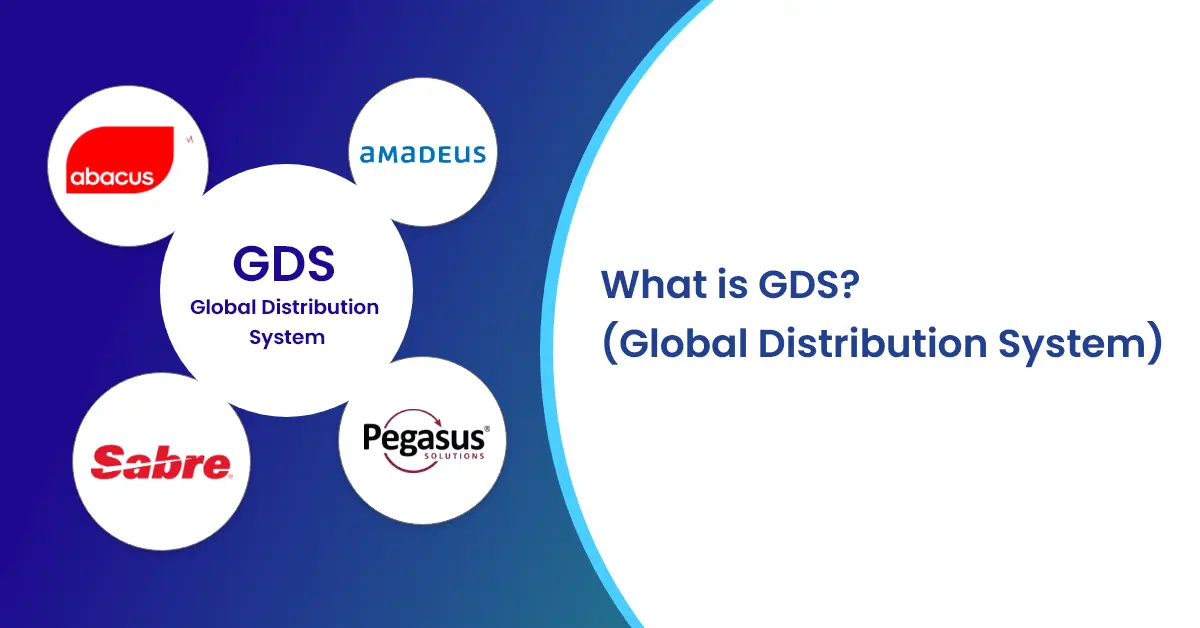
A Global Distribution System (GDS) is a centralized computerized network that enables travel agents, A Global Distribution System (GDS) is a centralized computerized network that enables travel agents, online travel agencies, and travel management companies to access and book travel services from multiple suppliers through a single platform.
These services include:
- Airline tickets
- Hotel reservations
- Car rentals
- Travel packages and ancillary services
Instead of checking different airline or hotel systems individually, a GDS allows users to search availability, compare prices, and make bookings in real time from one interface.
In simple terms, a GDS acts as a bridge between travel service providers (airlines, hotels, car rental companies) and travel sellers (agencies, OTAs, corporate travel platforms).
For travel agencies looking to streamline flight bookings, an Amadeus GDS Booking system can provide seamless access to extensive global flight inventory.
A Brief History of GDS
Understanding how GDS came to exist helps explain why it remains so important today.
In the 1960s, airlines faced a growing problem. As passenger volumes increased, manual booking processes became unsustainable. American Airlines, in partnership with IBM, developed one of the first computerized reservation systems (CRS) called SABRE in 1964. This system allowed airline agents to check seat availability and make reservations automatically, replacing a system that previously required manual phone calls between booking centers.
Through the 1970s and 1980s, airlines began sharing their inventory with travel agents through these systems. As demand grew, independent networks emerged that aggregated inventory from multiple airlines in one place. These became the first true Global Distribution Systems.
By the 1990s, GDS had expanded beyond flights to include hotels, car rentals, and rail services. Today, the three dominant GDS providers (Amadeus, Sabre and Travelport) collectively process hundreds of millions of transactions every year, making them a foundational layer of global travel commerce.
How Does a GDS Work in the Travel Industry?
A global distribution system connects directly with the reservation and inventory systems of airlines, hotels, and car rental companies. These suppliers push their inventory, pricing, availability and booking rules into the GDS in real time.
Here’s how the process works:
- Travel suppliers upload their inventory, pricing and availability rules into the GDS
- The GDS aggregates this data and keeps it updated continuously in real time
- Travel agents, OTAs or corporate booking tools search and compare available options
- The user selects and books, and the confirmation is sent instantly back to the supplier system
- The GDS charges a booking fee (per transaction) and may distribute a commission or incentive back to the agency
The GDS itself does not own any inventory. It acts as a real-time distribution and transaction layer between suppliers and sellers.
Key Features of a Global Distribution System
A modern GDS offers more than basic booking functionality. Some of the most important features include:
Real-Time Availability and Pricing
Agents can view live seat availability, hotel rooms and rental options with dynamically updated prices. Any change on the supplier side is reflected immediately.
Multi-Supplier Access
Flights, hotels and cars from hundreds of different suppliers can be searched and booked through a single interface. Amadeus, for example, connects to over 400 airlines and 900,000 hotel properties.
Centralized Booking Management
Bookings, cancellations, modifications and ticket reissuance can all be managed from one system, reducing the need for agents to log in to multiple supplier portals.
Reporting and Analytics
GDS platforms provide detailed reports on booking volumes, revenue, route performance and travel trends, which are especially valuable for corporate travel managers.
API and System Integration
All major GDS platforms expose APIs that allow travel businesses to connect GDS data directly with their booking engines, travel portals, CRM systems and mobile apps.
Negotiated Fares and Corporate Rates
GDS systems support loading of private fares, corporate rates and NDC content, allowing travel management companies to offer exclusive pricing to their corporate clients.

Benefits of Using a Global Distribution System
Using a GDS brings several advantages for travel businesses and agencies.
Wider Market Reach
A GDS connects travel suppliers to thousands of travel agents and online platforms worldwide, giving hotels, airlines and car rental companies exposure far beyond what direct marketing can achieve.
Faster Booking Process
Real-time data and instant confirmation reduce manual work and compress the booking journey from hours to seconds for both agents and end customers.
Improved Accuracy
Live pricing and availability data minimize booking errors, reduce overbooking incidents and lower the volume of customer complaints and support requests.
Better Revenue Opportunities
With access to global distribution channels, suppliers can increase booking volumes, optimize yield pricing and target high-value corporate and agency segments.
Essential for Corporate Travel
Many corporate travel programs are built entirely on GDS platforms. They use GDS for negotiated rates, policy enforcement, expense reporting, duty of care compliance and consolidated reporting. If you want to serve corporate travel clients, GDS is not optional.
Reduced Operational Cost
For travel agencies and TMCs, consolidating all supplier access into one platform reduces the cost and complexity of maintaining separate integrations with each airline or hotel chain.
GDS vs CRS vs OTA: What Is the Difference?
These three terms are closely related but serve different functions in the travel distribution chain.
CRS (Computer Reservation System)
A CRS is typically operated by a single supplier, such as an airline or hotel chain, to manage its own internal inventory and reservations. The supplier controls the CRS and uses it to track availability, process bookings and manage pricing.
GDS (Global Distribution System)
A GDS aggregates inventory from multiple CRS systems across many different suppliers and distributes that combined inventory to travel agents, OTAs and corporate booking tools globally. The GDS acts as the intermediary layer.
OTA (Online Travel Agency)
An OTA like Booking.com or Expedia is a consumer-facing booking platform. Many OTAs source their inventory from GDS systems, although some also connect directly to supplier APIs. The key difference is that an OTA sells to end travelers, while a GDS sells to travel agents and businesses.
In short:
- CRS manages inventory for one supplier
- GDS distributes that inventory globally to sellers
- OTA presents that inventory to end consumers
Think of the flow as: Supplier CRS → GDS → Travel Agent or OTA → Traveler.
Major GDS Providers: Amadeus, Sabre and Travelport
The travel industry relies primarily on three major GDS platforms:
Amadeus
Headquartered in Madrid, Amadeus is the largest GDS by transaction volume globally and has a particularly strong presence in Europe, Asia and Latin America. Amadeus also offers technology products beyond GDS, including property management systems and revenue management tools. OneClick IT Solution offers Amadeus API integration for travel businesses.
Sabre
Founded in the United States, Sabre is the dominant GDS in North America and is heavily used for corporate travel programs. It powers thousands of travel management companies and provides one of the most widely adopted back-office systems for travel agencies. OneClick IT Solution offers Sabre API integration for travel businesses.
Travelport (Galileo, Worldspan)
Travelport operates three legacy GDS systems under one umbrella: Galileo (strong in Europe and Asia Pacific), Worldspan (widely used by OTAs) and Apollo (primarily used in North America). Travelport has been pushing a modernized platform called Travelport+ to replace these legacy systems.
Who Should Use a GDS?
Not every travel business needs a GDS integration. Understanding who benefits most helps you decide whether it is the right investment for your platform.
You likely need GDS integration if you are:
- Building a B2B travel portal that sells to travel agencies or sub-agents
- Developing a corporate travel management platform
- Creating an OTA that needs access to broad flight and hotel inventory in real time
- Building a travel booking engine that needs to compare fares across multiple airlines
- Operating a travel management company (TMC) that handles business travel
- Developing white-label travel solutions for enterprise clients
You may not need a full GDS if you are:
- Building a niche leisure travel product (e.g., a specific tour operator or activity booking platform) where direct supplier APIs may be more cost-effective
- Operating in a market where a specific supplier API or bed bank provides adequate inventory coverage
- Building a small travel app with limited inventory needs
For most full-service travel platforms and portals, GDS remains the fastest and most reliable route to comprehensive global inventory. At OneClick IT Solution, we help you evaluate which integration approach is right for your business model and build accordingly.
How Much Does GDS Integration Cost?
GDS integration costs vary depending on the provider, the scope of services and whether you use a direct GDS connection or work through an aggregator.
GDS provider fees
All three major GDS providers charge a per-booking or per-segment transaction fee to travel agencies. Some also charge a subscription or connectivity fee. The exact rates are typically negotiated based on booking volumes, business type and regional agreements.
Integration development cost
Building a GDS integration requires connecting to provider APIs (such as Amadeus Travel APIs, Sabre REST APIs or Travelport Universal API), handling authentication, building search and booking flows, and managing cancellations and ticketing. Depending on complexity, this ranges from a focused integration to a full travel portal build.
Ongoing maintenance
GDS providers regularly release API updates, especially as they transition to NDC content. Your integration will require ongoing maintenance and support.
Working with an experienced GDS integration partner like OneClick IT Solution reduces both the time to launch and the risk of technical issues with provider systems. Talk to our travel tech team for a scoped estimate based on your requirements.
Role of GDS in Modern Travel Technology
Even with the rise of direct airline bookings and new distribution models, GDS continues to be a core part of the travel ecosystem. It remains especially important for:
- Travel agencies and tour operators
- Corporate travel management platforms
- Multi-supplier price comparison engines
- International travel distribution
Modern GDS platforms are also evolving by supporting NDC content, richer ancillary fare options, and improved REST API connectivity.
GDS and NDC: What Is Changing in Travel Distribution?
New Distribution Capability (NDC) is a data transmission standard developed by IATA that allows airlines to distribute richer content, including ancillary offers, seat upgrades and bundled fares, directly through API connections rather than through the traditional GDS model.
NDC does not replace GDS. Instead, it is changing how content flows within the GDS ecosystem:
- Major GDS providers including Amadeus, Sabre and Travelport have all built NDC capabilities into their platforms
- Airlines can now push NDC content through GDS channels alongside traditional inventory
- Travel agencies can access both traditional EDIFACT-based content and modern NDC offers from a single connection
For travel businesses building new platforms, this means a well-built GDS integration today should support both traditional content and NDC content to ensure complete inventory coverage.
OneClick IT Solution builds GDS integrations that account for NDC readiness, ensuring your travel platform is future-proof. Learn more about our GDS Integration services.
How to Integrate GDS into Your Travel Platform
Integrating a GDS into your travel portal involves several stages:
Step 1: Choose your GDS provider
Evaluate Amadeus, Sabre or Travelport based on your target market (geography, travel type, corporate vs leisure) and the APIs they offer. Amadeus Travel APIs and Sabre Dev Studio both offer developer-friendly REST interfaces.
Step 2: Apply for API access
Each GDS provider has an onboarding process for technology partners. You will typically need to register as a development partner, agree to usage terms and obtain API credentials.
Step 3: Build your integration
Your development team (or integration partner) will build the search, booking, ticketing, cancellation and reporting flows using the GDS APIs. This includes handling fare rules, tax calculations, PNR management and supplier-specific requirements.
Step 4: Test in sandbox
All major GDS providers offer sandbox environments for testing before going live. Thorough testing is essential given the transaction-critical nature of travel bookings.
Step 5: Go live and maintain
Once certified, your integration goes live. Ongoing maintenance is required as providers update their APIs and add NDC content.
OneClick IT Solution manages this entire process for travel businesses, from API access to live deployment. Start a conversation with our team to discuss your GDS integration project.
Why Choose OneClick IT Solution for GDS Integration?
At OneClick IT Solution, we help travel businesses build reliable and scalable solutions using global distribution systems. Our team has hands-on experience integrating Amadeus, Sabre and Travelport into B2B portals, B2C booking engines and corporate travel platforms.
Our services include:
- GDS API integration (Amadeus, Sabre, Travelport)
- B2B travel portal development and B2C travel portal development
- Real-time flight booking engine and hotel booking engine development
- NDC integration and future-ready API architecture
- Custom white-label travel software solutions
We focus on performance, scalability and smooth user experience, ensuring your travel platform is ready for global distribution.
Final Thoughts
A Global Distribution System (GDS) remains one of the most powerful infrastructure layers in the travel industry. From expanding market reach to enabling real-time bookings across hundreds of suppliers, GDS plays a vital role in how travel services are distributed and sold worldwide.
Whether you are building a new travel platform, upgrading an existing portal or evaluating whether GDS integration is right for your business, the right technology partner makes all the difference.
Frequently Asked Questions
What does GDS stand for in travel?
GDS stands for Global Distribution System. It is a centralized network used by travel agents, OTAs and corporate travel platforms to search, compare and book flights, hotels and car rentals from multiple suppliers in real time.
What are the three main GDS systems?
The three main GDS providers are Amadeus, Sabre and Travelport. Travelport operates three legacy platforms: Galileo, Worldspan and Apollo.
Is GDS still relevant today?
Yes. Despite the growth of direct booking channels and OTAs, GDS remains the primary distribution channel for corporate travel globally. It also continues to be the backbone of multi-supplier inventory access for travel agencies and travel management companies.
What is the difference between GDS and OTA?
A GDS distributes inventory to travel agents and business travel platforms. An OTA like Expedia or Booking.com is a consumer-facing booking website that may itself use a GDS to source inventory.
Do I need GDS to build a travel booking platform?
It depends on your use case. If you are building a corporate travel platform, B2B travel portal or full-service OTA, GDS integration is typically required. For niche leisure travel products, direct supplier APIs may be sufficient.
How do I integrate GDS into my travel website?
GDS integration requires connecting to provider APIs (Amadeus, Sabre or Travelport), building booking and ticketing flows, and managing ongoing updates. Most travel businesses work with a specialist integration partner like OneClick IT Solution to handle this.