 AI & ML
 MOBILE APP DEVELOPMENT
 AI-Powered Solutions
 Business App Solutions
 TRAVEL BOOKING ENGINE
 TRAVEL PORTAL DEVELOPMENT
 FRONTEND
 MOBILE
 Trending Technology
 ABOUT COMPANY
 AI & ML
 MOBILE APP DEVELOPMENT


Travel Technology Development: Complete Guide for Travel Businesses
The travel industry is undergoing an immense change due to all of the advancements in technology. Technology provides a way for travelers, agencies, hotels, airlines, and tour operators to stay connected with each other through smart technology solutions. Using automated booking systems, customized itineraries, integrated APIs, and real-time data processing, travel companies can improve their productivity, cut costs, and improve their customer experience. Whether you are a travel agency looking to automate your workflow, an airline wanting to distribute directly via NDC, or a company offering white-label solutions, you’re going to need to understand how travel technology works. This handbook outlines breakthroughs, trends, and strategies to help travel companies grow and succeed.
What Is Travel Technology Development?
Travel Technology Development is creating an easy-to-use software application, online platform, or digital solution that helps create a more efficient operation from the beginning until after it occurs. Examples include creating online booking engines, managing travel schedules, integrating with suppliers, and providing up-to-date data tools to use to build your itinerary. Through the use of travel technology, both travel companies, such as travel agencies, airlines, and tour operators, can operate more efficiently, reduce their overhead costs, provide unique experiences, and make it easier for travelers to enjoy their experience.
Travel Portal Development Explained
Travel portal development entails the creation of digital platforms where users can explore, evaluate, and purchase travel and related services such as transportation (airline, bus, or train), accommodation, and leisure/holiday packages, to deliver a seamless travel experience for customers and assist travel agencies in administering their business operations effectively and efficiently.
Travel Portals
A travel portal provides a digital platform for booking travel, accommodation, or leisure/holiday services. As a comprehensive solution for customers, travel portals also support businesses by streamlining the process of managing service availability and bookings.
Features of Travel Portals
A successful travel portal will include at least the following features. It includes comprehensive and customizable site search capabilities, instant booking options, secure payment processing, 24/7 access to customer support, and personalized recommendations for each customer. Access to up-to-date inventory and rates for travel products is possible through connectivity with third-party suppliers via an API. Other features that enhance customer engagement and personalization solutions include customer reviews, the ability to set up notifications, the selection of multiple currencies, and loyalty programs.
Technology Stack and Platform Selection
Selecting the appropriate technology stack is the first step to developing a travel portal. Front-end frameworks like React or Angular, back-end languages like PHP, Python, or Java, and databases such as MySQL or MongoDB are frequently chosen by developers. Besides, cloud services and server infrastructure support scalability, performance, and reliability, especially during the booking rush.
Travel API Integration
API integration is a vital element in the creation of a travel portal. It links the portal to airlines, hotels, car rental companies, and other service providers, enabling real-time data exchange. Travel APIs, such as GDS (Global Distribution System), NDC (New Distribution Capability), and third-party travel aggregators, enable a travel portal to provide customers with instant, accurate pricing, availability, and booking confirmation.
Customization and White-Label Solutions
Many travel companies opt for a white-label travel portal that they can rebrand with their logo, domain, and colors. Customization enables businesses to add features such as local payment methods, advertisements, or exclusive travel packages, helping them stand out in the marketplace.
Benefits of Travel Portal Development
A travel portal helps travel companies by streamlining operations, reducing manual labor, improving the customer experience, and expanding market reach. Through instant booking, automatic notifications, and built-in analytics, businesses get the support they need to make smart decisions, enhance service quality, and increase earnings. On the other hand, travelers are getting the advantage of the convenience, clarity, and variety of options all in one place.
Travel API Integration (Flight, Hotel, Car)
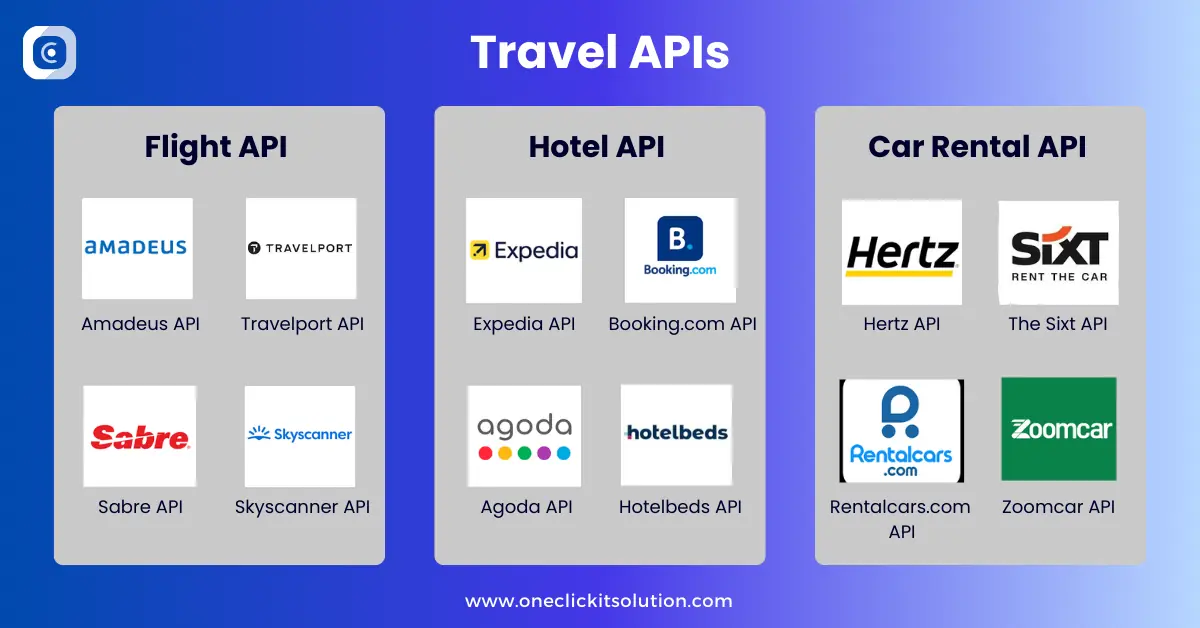
Travel API integration establishes a connection between portals and the providers of flights, hotels, and car rentals. This not only facilitates up-to-date searches, bookings, and prices but also enables the smooth exchange of data, resulting in the accurate, efficient, and user-friendly delivery of travel services.
1. Flight API Integrations
Amadeus API
Portals that have integrated with the Amadeus API have access to the worldwide flight data, which allows them to do a flight search, show the different price levels, make the booking, cancel the booking, and issue the ticket all on a real-time basis, thus enhancing the tourist’s convenience and the efficiency of the operation.
Sabre API
Sabre API interlinks travel portals with a multitude of airlines, delivering, among other things, real-time flight schedules, fare updates, seat selection, bookings, and ticket management, making the trip-planning process for customers extremely straightforward while providing businesses with accurate data.
Travelport API
Travelport API combines several GDS systems, enabling travel portals to access airline inventory, prices, and various booking options immediately while facilitating ticket issuance, cancellations, and itinerary management in a manner that is both precise and quick.
Kiwi API
Kiwi API enables multi-airline flight searches, fare comparisons, and instant booking confirmations. Through portals, travelers can benefit from flexible route options with low-cost carriers, along with live information and automated ticketing.
Skyscanner API
The Skyscanner API collects flight data from multiple airlines and OTAs, providing real-time prices, availability, and booking options. With features that enable easy flight comparison, travelers are better informed and more in control of their choices.
Lufthansa API
Lufthansa API enables portals to offer up-to-date flight schedules, seat availability, fare details, and booking functionality without relying on the airline, thereby facilitating accurate pricing and ticket confirmation for travelers.
AirAsia API
AirAsia API links travel platforms directly to airline schedules, fares, and booking data, together with real-time availability and bookings. With one-stop shopping, users can select seats, pay, and receive tickets instantly.
Emirates API
Emirates API incorporates flight search, pricing, availability, and secure booking features. Also, through a portal, users can avail of services such as ticketing, cancellation, and itinerary management directly, thus enjoying both reliable service and comfort.
2. Hotel API Integrations
Expedia API
The Expedia API is a bridge between travel portals and global hotel inventories. It offers real-time room availability, pricing, booking, and cancellation options without compromising on accurate automated confirmations and customer satisfaction.
Booking.com API
The Booking.com API opens access to several thousand properties worldwide for the portals. With the API, the portal app can provide hotel rooms filtered by instant search, rates, availability, booking, and cancellation, for a smooth, easy user experience when booking hotels.
Agoda API
Agoda API is a technical connection between the hotel property management system and third-party platforms. The Agoda API provides real-time availability, pricing, booking, and cancellation services to end users, supports personalized search filters, and ensures secure payment processing across travel platforms.
Hotelbeds API
The Hotelbeds API is every travel portal’s dream come true because it provides a vast network of hotels to users, along with dynamic pricing, availability, and booking services. Thus, it is a great service to travelers worldwide in making their hotel reservations truly real-time and reliable.
Priceline API
Priceline API is a functional integration that connects travel platforms to hotels’ inventory, offering instant search, fare comparison, bookings, and cancellation options without compromising on competitive pricing for end users.
TripAdvisor API
TripAdvisor API services include hotel reviews, ratings, availability, and pricing, which travel portals can use to facilitate greater user decision-making, and, thus, the booking confidence of travelers can also be improved.
Airbnb API
The Airbnb API helps portals find and book properties more easily by providing listings, availability, pricing, and booking options. In addition, users can take advantage of reservation management, cancellation, and payment security.
MakeMyTrip API
The MakeMyTrip API is an interface that connects travel portals to Indian hotel listings, rates, bookings, cancellations, and itinerary management, ensuring smooth, real-time customer interactions.
3. Car Rental API Integrations
Hertz API
The Hertz API links portals to rental car inventory and live rates, reservations and cancellations, and pick-up/drop-off management, creating seamless car rental experiences for customers.
The Sixt API
It provides portals with access to vehicle searching, pricing, availability, booking, etc., and manages the pick-up/drop-off experience to provide customers with a seamless experience.
Enterprise API
This connects platforms to vehicle inventory, pricing, reservations, cancellations, and location management, and provides seamless customer interactions with live bookings and customer service.
Rentalcars.com API
It consolidates multiple rental suppliers, enabling portals to search, compare, reserve, and even cancel vehicle bookings while providing secure payment methods.
Kayak Car API
This combines multiple rental suppliers to provide portals with real-time availability, pricing, bookings, and cancellations for consumers worldwide with seamless access.
Expedia Car API
It provides portals with the ability to search, compare, reserve, and manage rental vehicles in real time with secure payment and cancellation methods.
Skyscanner Car API
This API provides travel portals with access to the global car rental market with the ability to search for rental vehicles, compare fares, book in real-time, and manage cancellations.
Zoomcar API
Zoomcar API assimilates the self-drive vehicle inventory, pricing, booking, and pickup/drop options, thus enabling portals to provide travelers with flexible car rental services.
B2B vs B2C Travel Portals
| Feature | B2B Travel Portal | B2C Travel Portal |
| Target Audience | Travel agents, tour operators, corporate clients | Individual travelers, tourists, general public |
| Purpose | Provide bulk bookings, supplier management, and agent tools | Direct booking of flights, hotels, cars, and packages for end-users |
| Booking Volume | High-volume, bulk bookings | Single or small group bookings |
| Pricing Model | Wholesale rates, commission-based | Retail pricing, discounts, dynamic pricing |
| Features | Agent management, multi-user login, API integration with multiple suppliers | User-friendly search, filters, reviews, secure payment, itinerary management |
| Revenue Source | Commissions from suppliers, service fees | Direct sales, booking fees, add-ons |
| Customization | Highly customizable for corporate needs and travel agencies | Personalized recommendations, offers, and loyalty programs |
| Support | Dedicated account managers, B2B support channels | Customer service, live chat, self-service options |
| Technology | Advanced APIs, reporting dashboards, multi-supplier integrations | Mobile apps, responsive web portals, payment gateway integrations |
| Market Approach | Targets partnerships with other businesses | Targets end-users and mass market directly |
There are two primary varieties of travel portals, B2B and B2C, intended for different audiences and different purposes. B2B travel portals link travel agents, tour operators, and corporate clients for bulk bookings, multiple integrated APIs from sources, agent management, and wholesale prices. They primarily focus on efficient, high-volume, commission-based transactions. B2C travel portals are for individual travelers. They offer easy-to-search options, instant bookings (flights, hotels, and rental cars), personalized recommendations, loyalty programs, and retail pricing.
Whereas B2B is focused on business scale and efficiency, B2C is focused on delivering a positive experience for the customer through ease of use. The choice made regarding the preferred portal type is primarily determined by its intended users and business objectives, along with the variety of services to be offered.
Advantages of Custom Travel Booking Engines
1. Personalization of Effects and Sea ching for the Customer
Customizable booking engines allow travel businesses to define exactly what their customer’s booking experience will be, including how search filters and recommendation systems will design the interface, so that they match the demographic the business is trying to attract. Customized booking engines also make it possible for travel businesses to provide travelers with choices that will win them over and ultimately contribute to higher conversion rates.
2. Real-Time Availability and Pricing
The integration of different suppliers through an API offers agencies up-to-date availability for flights, hotels, and rental cars through automated real-time updates from each of their suppliers. This API solution removes many customer-related errors as a result of real-time updates from suppliers, reduces the occurrence of overbookings, and gives customers access to the most recent rate and availability data immediately.
2. Reduced Hours of Operation
Technology-driven travel agencies rely heavily on automating their entire agency’s operations, including booking processes, payment processes, and customer service. By automating these functions, technology has decreased the amount of time that staff and/or employees spend working on booking and payment functions, which reduces the likelihood of errors due to human inputs and reduces the overall amount of staffed hours that an agency uses to provide service. This means that travel agencies are able to allocate more of their resources to providing excellent customer service.
3. Unique Selling Position
As custom technology-based automation continues to improve, travel agencies will have the ability to create unique products and features, including but not limited to custom packages, dynamic pricing, or local offerings. This means that travel agencies can differentiate themselves from their competitors by tailoring their products and services to meet their target customers’ needs.
4. Long-Term Viability
Because of the way that many agencies have built their businesses, and as a result of changes in their business or supplier relationships, they will continue to evolve and expand their systems to increase efficiency. As businesses grow, they will also continue to build the capacity to continuously host more customers, provide additional services, and add new suppliers to support their evolving customer needs.
5. Flexibility to Change
Custom systems will give businesses the ability to continually develop their business as they see fit. Over time, a company can redesign its business model or procedures without losing the ability to maintain or support its customers. Therefore, companies can successfully navigate through turbulent market or economic conditions, while still providing service for their hundreds of customers or providing a variety of services to hundreds of customers.
How to Choose a Travel Tech Development Company?
1. Define Your Requirements
Before contacting any company, you should prepare a project plan that clearly outlines goals, features, and the target audience. Decide whether you will need a B2B, B2C, or hybrid travel portal, API integrations for flights, hotels, and cars, as well as custom functionalities. Clarifying your scope will enable you to choose a partner that suits your requirements.
2. Assess the Level of Technical Expertise
Look for a company with a solid history of travel technology development. They should have the expertise to develop travel portals, integrate APIs like Amadeus, Sabre, and Expedia, manage payment gateways, and deal with secure, scalable systems. Evaluate their technologies and previous works to see if they are pertinent.
3. Review Portfolio and Case Studies
A comprehensive portfolio speaks volumes about a person’s practical experience. Analyze the case studies to check if the company is facing challenges that are similar to yours, if they can deliver the solution on time, and how they integrate the systems of suppliers or third parties. Real cases give confidence in their abilities.
4. Assess Industry Knowledge
Travel technology companies should be aware of the intricate nature of the travel industry, such as the booking processes, dynamic pricing, NDC standards, and regulatory requirements. Having an understanding of the industry enables a development team to come up with viable solutions and not mere off the shelf software.
5. Review Client Testimonials and References
Wherever possible, find out about the experience of previous clients and ask them questions if allowed. Good customer satisfaction records concerning the completion of the project, communication, and support after the launch demonstrate the company’s dependability and professionalism. Also, a company’s references give you an idea of the ability for a long-term partnership.
6. Evaluate Communication and Support
Communication that is clear and effective plays a very important role in the success of the project. The company must provide transparent progress reports, collaborative tools that are adaptable, and a customer service team that is available anytime during and after the development. Misunderstandings can be avoided through good communication, and it also helps to keep the project moving as planned.
7. Consider Budget and Timeline
Assess the offers based on features, level of complexity to implement, and the overall level of support after you launch your solution. The inexpensive option is not necessarily the most appropriate option. Each potential solution must be judged on its merits regarding value, quality, and ability to deliver on time. You must confirm that the company can meet your needs without compromising the quality of service or delivery.
Conclusion
The evolution of travel technology has significantly changed the travel sector by allowing travel businesses to deliver seamless experiences to their customers; customizable booking solutions & systems for travel suppliers and APIs for seamless integration into existing business processes are being utilized by travel companies. The availability of effective and efficient application development partners will allow travel companies to develop reliable, scalable, and secure applications. Therefore, with the availability of effective and efficient technology-based applications such as these, travel companies will continue to maintain their competitive advantages, improve customer satisfaction levels, and facilitate their future growth by operating in an increasingly competitive digital marketplace.
FAQs
What Is Travel Technology Development?
Travel technology development involves developing technology platforms, applications, and software that enable items such as reservations, itinerary management, supplier integration, enhancing the traveller experience, and enhancing the overall functionality of travel agencies, tour operators, and hospitality businesses.
How Does Travel API Integration Work?
Travel APIs enable travel suppliers to connect with different travel platforms and their suppliers (e.g., airlines, hotels, rental car companies) for real-time data exchange, automated reservations, pricing updates, availability checks, and workflows, providing customers with a seamless transaction experience.
What Is NDC In Travel Technology?
NDC (New Distribution Capability) is an IATA-established airline industry standard for creating more detailed product descriptions, custom offers for customers, and a more direct method for airlines and travel agencies to connect with and distribute to their customers via API.
How Much Does Travel Portal Development Cost?
The cost to develop a travel portal depends on factors such as features, integrations, design complexity, and any required custom solutions. A simple travel portal may cost between $5,000 and $10,000, while a full enterprise solution with an API may cost $30,000 or more.
What Is A White-Label Travel Solution?
A white-label travel solution is an off-the-shelf booking platform that can be rebranded with a company’s logo, domain, and branding. It allows businesses to effortlessly launch travel services without having to build technology solutions from scratch.