
 AI & ML
 MOBILE APP DEVELOPMENT
 AI-Powered Solutions
 Business App Solutions
 TRAVEL BOOKING ENGINE
 TRAVEL PORTAL DEVELOPMENT
 FRONTEND
 MOBILE
 Trending Technology
 ABOUT COMPANY
 AI & ML
 MOBILE APP DEVELOPMENT


Skyscanner Flight API: A Complete Guide for Travel Portals and OTAs (2026)
If you run a travel portal, OTA, or B2B travel platform, you have almost certainly come across Skyscanner and wondered whether you can plug its flight search power directly into your product. The Skyscanner Flight API is one of the most talked-about tools in the travel tech space, but access works very differently from what most people expect.
Running a travel portal or OTA and wondering if you can plug Skyscanner’s flight search directly into your platform? Whether you are building a booking engine from scratch, adding flight search to an existing portal, or offering real-time fare comparisons to your B2B clients, this guide walks you through exactly how the Skyscanner API works, who can access it, what it actually costs, and which alternatives are worth considering in 2026.
What is Skyscanner Flight API?
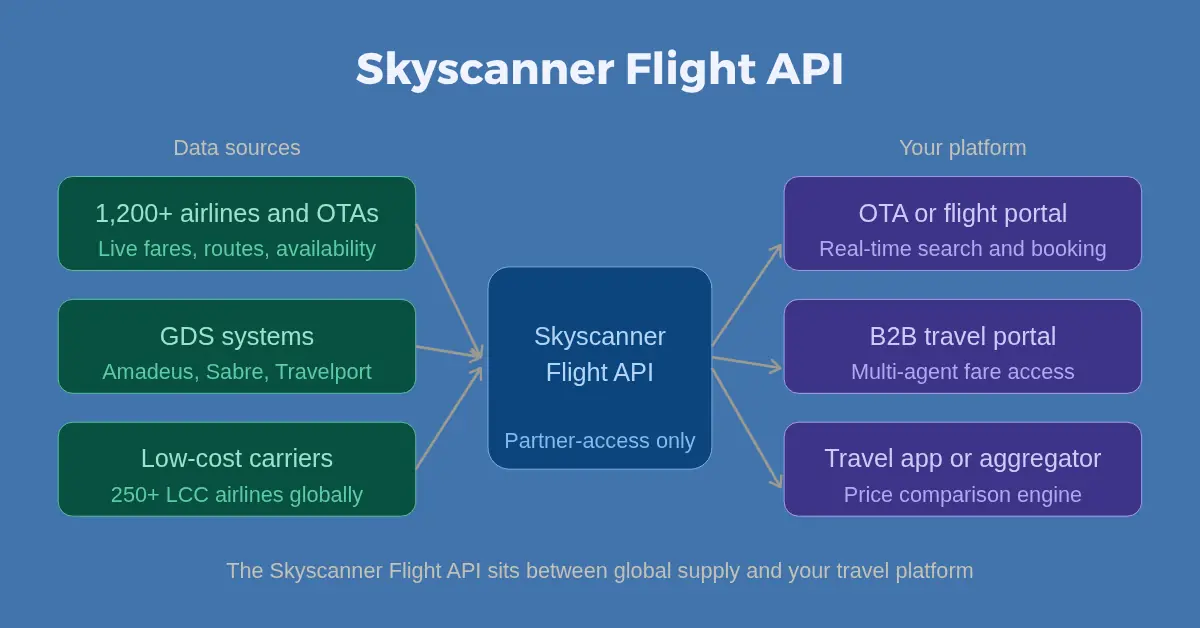
Skyscanner is a global flight meta-search engine that aggregates pricing and availability from over 1,200 airlines, OTAs, and travel aggregators in real time. It covers more than 52 markets and 30 languages, which makes it one of the most comprehensive flight data sources available for travel businesses that want to serve an international audience.
The Skyscanner Flight API is the programmatic interface that powers this search. It lets approved partners query live flight prices, search across routes and dates, access cached indicative pricing for flexible date searches, and retrieve geo data covering airports, cities, and countries. For a travel business, this means you can embed Skyscanner-quality flight search directly into your platform rather than redirecting customers to the Skyscanner website.
Skyscanner API Key Capabilities for Travel Portals
- Flights Live Prices API: real-time fare and seat availability for specific routes and dates
- Flights Indicative Prices API: cached pricing for flexible date and multi-destination searches
- Geo API: full catalogue of supported airports, cities, and countries for location autocomplete
- Car Hire Live Prices API and Hotels Live Prices API: bundled options for complete travel portal builds
Does Skyscanner Offer a Public API? Here Is the Honest Answer
This is the most important thing to understand before you spend any time planning an integration. Skyscanner does not offer a self-serve public API that anyone can sign up for and start using immediately. The Skyscanner API is a partner-only product.
To access the API, you need to apply through the Skyscanner Partner Portal. Skyscanner reviews each application and their team typically responds within two weeks. If approved, you get a dedicated account manager, engineering support, and access to their developer documentation. If you are not an established travel business with an existing audience, approval is not guaranteed.
What this means for your travel business:
- Travel startups in early stages may not qualify for direct Skyscanner API access
- Approved partners get access to real-time flight data, revenue tracking, and co-branded search tools
- There is no publicly available Skyscanner API key for general use, making third-party alternatives the practical path for many businesses
- The skyscanner api documentation referenced in many developer guides is only available inside the partner portal after approval
How the Skyscanner API Works for Travel Platforms
Once a travel business is approved as a Skyscanner partner, integration works by querying the API endpoints with your credentials and rendering the results inside your product. Skyscanner provides two core search modes, and understanding the difference matters for how you architect your product.
Live pricing vs cached pricing: which does your portal need?
- Live Pricing (Flights Live Prices API) returns accurate, real-time fares for specific routes and dates. This is what powers Skyscanner’s own main flight search. Use this when your users are ready to compare and book specific trips. The trade-off is that it is slower and requires precise query parameters.
- Indicative Pricing (Flights Indicative Prices API) returns cached prices for broad, flexible searches. Use this for features like “cheapest month to fly” or “best deals from London” on your homepage. Results load faster but may not reflect the most current fares on less popular routes.
Most travel portals that integrate the Skyscanner API use both modes together, serving indicative prices for inspiration and discovery, and switching to live pricing when users get serious about booking.
How Travel Businesses Are Using the Skyscanner Flight API
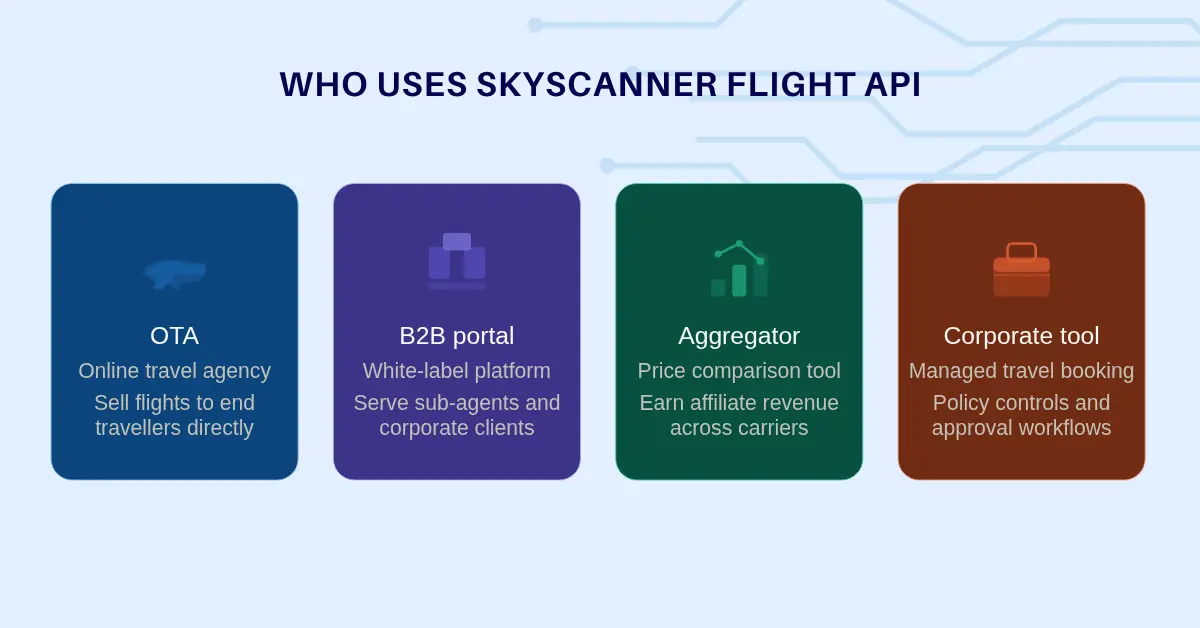
OTAs and flight booking portals
Online travel agencies use the Skyscanner API to power their flight search, showing live fares from hundreds of airlines side by side without needing direct relationships with each carrier. This dramatically reduces the commercial complexity of building competitive inventory, especially for newer OTAs that have not yet negotiated bilateral deals with airlines.
B2B travel portals and white-label platforms
Travel technology companies offering white-label portals to sub-agents or corporate clients use the Skyscanner API to give those clients access to global flight inventory without each client needing their own API contracts. Our custom flight booking solutions at OneClick IT are often built this way, combining Skyscanner or GDS data with a multi-level markup and commission engine for B2B operators.
Travel aggregators and price comparison tools
If your business model is based on comparing fares and earning affiliate commission, Skyscanner’s partner programme includes revenue-sharing on bookings driven through your platform. The API feeds your search results while the commercial arrangement handles monetisation.
Corporate travel management tools
Corporate booking tools use the flight API to pull live pricing for employee travel booking, often combined with policy controls, approval workflows, and reporting dashboards. The real-time data is essential for accurate cost tracking before trips are approved.
Skyscanner API Access: How to Apply and What to Expect
The application process for Skyscanner API access is straightforward but selective. Here is what the journey looks like for a travel business.
- Visit the Skyscanner Partner Portal at partners.skyscanner.net and submit an application with details about your platform, your audience size, and what you want to build
- Skyscanner reviews applications and responds within approximately two weeks
- If approved, your dedicated account manager will walk you through onboarding and provide access to the Skyscanner flights API documentation
- You will receive API credentials and can start integration using the developer hub resources
- Ongoing support is available through Skyscanner’s engineering support team
One common question is whether a Skyscanner API key is available for free testing. Skyscanner does provide test environment access to approved partners, but there is no public free tier in the way that some other APIs offer. If you are not yet at the partnership stage, we recommend beginning with an alternative that has a free sandbox, then migrating to Skyscanner once your platform reaches the required scale.

Skyscanner API Pricing: What Does It Actually Cost?
Skyscanner does not publish API pricing publicly. The commercial terms are negotiated as part of the partnership agreement and vary based on your platform size, the volume of searches you generate, and the revenue you drive through the API.
For established travel businesses, the Skyscanner API can be highly cost-effective because the primary model is revenue sharing rather than a flat usage fee. Instead of paying per API call, partners typically earn commissions on bookings made through their platform with Skyscanner as the redirect or booking destination.
What this means in practice:
- There is no fixed monthly fee published for general developer access
- Commercial terms are tied to your traffic and booking volume
- Small startups or platforms without significant existing traffic should expect to explore alternatives first
- Enterprise partnerships can include custom SLAs, dedicated infrastructure support, and white-label options
If skyscanner api pricing is a key decision factor for your business, we can help you evaluate the total cost of ownership across multiple flight API options, including GDS integrations, third-party meta-search APIs, and Skyscanner’s partner programme. The right choice depends heavily on your business model and expected booking volumes.
Key Features of the Skyscanner Flight API
Real-time and cached flight data
Switch between live pricing and indicative pricing depending on the user journey stage. Live pricing for committed search, cached pricing for discovery and inspiration pages.
Global coverage
Access flight data from 1,200 supply partners, covering more than 52 markets and 30 languages. This makes it particularly strong for platforms serving international users or wanting to localise by currency and language.
Flexible search filters
Query by route, date, airline, cabin class, number of stops, and price range. Advanced filtering lets you surface the results most relevant to your users.
Multi-language and multi-currency support
Localise results for different markets without building separate data pipelines. Particularly useful for B2B platforms serving agents across multiple regions.
Revenue and performance analytics
Approved partners get access to a partner portal that tracks impressions, clicks, and bookings, giving you data to optimize placement and conversion.
Scalable architecture
The API is built to handle high-traffic environments, which is important for OTA platforms during peak booking seasons.
Skyscanner API Limitations to Know Before You Decide
No platform is perfect for every use case. Here is what to factor into your decision before committing to Skyscanner API integration.
- Access is partner-restricted: you cannot start building immediately. The application and approval process takes time, and approval is not guaranteed for early-stage platforms.
- No direct booking capability: Skyscanner is a meta-search platform, not a booking engine. Users are redirected to airlines or OTAs to complete bookings, which means you do not own the booking flow end to end.
- Scraping is not a workaround: several tools are marketed as a skyscanner scraper api alternative. Using these violates Skyscanner’s terms of service and creates legal and reliability risks for your platform. We strongly advise against this approach.
- Pricing is opaque: without access to Skyscanner’s partner terms, budgeting for integration requires a direct conversation with their team.
- Not ideal for ticketing-first platforms: if you need to issue tickets, manage post-booking services, or handle cancellations programmatically, you need a GDS API alongside or instead of Skyscanner.
Not sure which flight API fits your platform? Talk to our travel tech team
Skyscanner API Alternatives for Travel Portals in 2026
Because Skyscanner API access is restricted, most travel businesses explore alternatives first and come back to Skyscanner once they hit the traffic thresholds for partnership. Here are the main options, and what each one is best suited for. You can also read our full guide to the top flight booking APIs for OTAs for a deeper comparison.
GDS APIs: Amadeus, Sabre, Travelport
Global Distribution System APIs are the gold standard for travel businesses that need full-cycle booking capability, not just search. Amadeus API integration, Sabre API integration, and Travelport give you access to airline inventory, fare rules, seat maps, and the ability to issue tickets and manage post-booking services, all in a single integration.
Best for: OTAs, B2B travel portals, corporate booking tools, and travel management companies that need complete control over the booking journey
Kiwi.com Tequila API
Kiwi.com’s Tequila platform is popular for travel businesses that want to offer flexible and creative itineraries, including virtual interlining where flights from different carriers that do not normally connect are combined into single journeys. It connects to around 750 carriers including more than 250 low-cost carriers.
Best for: platforms targeting budget travellers, flexible itinerary builders, and startups that want a free-to-access flight search API with broad LCC coverage
- Registration is self-serve and the API is accessible after signing up, making it much faster to get started than Skyscanner’s partner application process
Expedia Rapid API
Expedia Rapid API is particularly strong for platforms that want to bundle flights with hotels and car hire. Expedia API integration gives you access to one of the largest hotel inventories in the world alongside flight content, making it well-suited for full travel package platforms.
Best for: OTAs and travel platforms that want a single API for multi-product inventory (flights, hotels, activities)
Duffel API
Duffel is a newer entrant that offers a modern REST API for direct access to airline content, including NDC-capable airlines. It is notable for supporting the full booking flow including ticketing, seat selection, and ancillary services, with relatively developer-friendly onboarding compared to legacy GDS systems.
Best for: tech-first travel startups that want clean API design and direct NDC access without legacy GDS complexity
Skyscanner vs Alternatives: Quick Comparison for Travel Businesses
| API | Best For | Access | Booking Capability | Pricing Model |
| Skyscanner API | Metasearch / aggregators | Partner approval | Search only (redirect) | Revenue share, no public pricing |
| Amadeus API | OTAs / enterprise | Self-serve sandbox | Full booking + ticketing | Per transaction / volume tiers |
| Kiwi Tequila API | LCC / flexible trips | Self-serve signup | Search + book | Commission-based |
| Duffel API | Modern OTAs / NDC | Application-based | Full booking + NDC | Per segment fee |
| Expedia Rapid API | Multi-product portals | Partnership | Search + hotel bundle | Commission-based |
| Sabre API | Agencies / TMCs | Contract required | Full GDS booking | GDS transaction fees |
How to Choose the Right Flight API for Your Travel Portal
The right choice depends on three things: where your platform is today, what kind of travel product you are building, and what your users need from the booking experience.
- Choose Skyscanner API if: you have an existing travel platform with meaningful traffic and want to add meta-search flight comparison or benefit from Skyscanner’s brand recognition in your market.
- Choose Amadeus, Sabre, or Travelport GDS if: you need full booking capability, want to issue tickets directly, or are building a B2B platform that requires complete post-booking management.
- Choose Kiwi Tequila if: you are a startup or early-stage platform that wants fast access to a broad flight search API without a lengthy approval process, especially if your focus is budget or flexible travel.
- Choose Duffel if: you want a modern API architecture with NDC airline access and are building a product that needs clean developer experience alongside booking capability.
If you are unsure which combination fits your business model, our travel technology team at OneClick IT can walk you through the options based on your specific platform type, target markets, and projected booking volumes. We have built travel API integrations across all major providers and can help you avoid the common mistakes that slow down integration projects.
Skyscanner Flight API Is Powerful. But Is It the Right Fit for Your Platform?
The Skyscanner Flight API is one of the most comprehensive flight data sources available for travel businesses, covering 1,200+ supply partners across 52 markets with revenue-sharing terms that work well for established OTAs and aggregators. But partner-only access means most platforms need to start with alternatives and scale toward Skyscanner as their audience grows.
Whether you integrate Skyscanner directly, build on a GDS like Amadeus or Sabre, or launch faster with Kiwi’s Tequila API, the decision comes down to one thing: which API fits where your platform is today, not just where you want it to be. Choose the right foundation and everything else, bookings, conversions, and user trust, follows.
FAQs on Skyscanner Flight API
There is no publicly available free tier for the Skyscanner API. Access is restricted to approved commercial partners, and pricing is negotiated as part of the partnership agreement. The primary commercial model for partners is revenue sharing on bookings, rather than a fixed subscription fee.
The Skyscanner API is the official, partner-approved method of accessing Skyscanner flight data. A Skyscanner scraper is an unofficial tool that extracts data from the website without permission. Using a scraper violates Skyscanner’s terms of service and creates serious legal and operational risk for your business. We recommend avoiding scraper-based solutions entirely.
No. The Skyscanner Flight API is a meta-search tool, not a booking engine. When a user selects a flight, they are redirected to the airline or OTA to complete the booking. If you need direct booking capability inside your platform, a GDS integration such as Amadeus or Sabre is the right solution.
For a new OTA, we recommend starting with Amadeus Self-Service API for its free sandbox and full booking capability, or Kiwi Tequila API for faster access and strong LCC coverage. As your platform scales and meets Skyscanner’s partner requirements, you can add Skyscanner’s meta-search layer on top.
A travel technology company like OneClick IT Solution can help you assess whether your platform qualifies for Skyscanner’s partner programme, guide the application process, and build the integration if approved. For businesses not yet at the Skyscanner partnership threshold, we can integrate the right alternative API for your current stage and future-proof the architecture so migration is straightforward when the time comes.