 AI & ML
 MOBILE APP DEVELOPMENT
 AI-Powered Solutions
 Business App Solutions
 TRAVEL BOOKING ENGINE
 TRAVEL PORTAL DEVELOPMENT
 FRONTEND
 MOBILE
 Trending Technology
 ABOUT COMPANY
 AI & ML
 MOBILE APP DEVELOPMENT


Custom Software Development Services in 2026: Complete Business Guide
Custom software development services enable businesses to create custom solutions that align with their specific objectives, workflows, and client requirements. In contrast to pre-built applications, custom software solutions are more flexible and scalable, giving companies a competitive edge. Today, businesses of all sizes, from startups to large corporations, are investing in custom software to increase their productivity, carry out automation, and provide users with superior experiences.
This comprehensive guide will help businesses understand custom software development, its benefits, key types, development stages, cost implications, and how to choose the right partner to achieve long-term success and a substantial return on investment.
What Is Custom Software Development?
Custom software development is the practice of creating, deploying, and supporting software products tailored to the precise needs of a single company. Unlike ready made software, custom software is tailored to specific business processes, workflows, and user requirements to specific business processes, workflows, and user requirements, resulting in greater efficiency and flexibility.
Such solutions comprise a variety of products, e.g., web and mobile applications, enterprise systems, automation tools, and industry-specific platforms. By working with an experienced custom software development company, organisations can create technology that evolves with their growth, improves productivity, and delivers a more personalised experience for both employees and customers.
Custom Software vs Off-the-Shelf Software
Customisation and Flexibility
Custom software is software built to meet the specific requirements of a business and thus offers tailored features and workflows to users. On the contrary, pre-designed software has very few customisation options since it is designed for a large, general audience.
Cost Structure
Custom software entails a greater initial investment but can be a real long-term asset, as it saves on license costs. Pre-built software offers a lower purchase price but is likely to include subscription or upgrade costs.
Implementation Time
Because ready-made software is already developed, it can be implemented almost instantly. Developing custom software will take longer; however, you will get a product tailored to your business needs and objectives.
Scalability and Growth
When a company expands, custom software can be scaled up easily to include new features and upgrades. Ready-made commercial software may limit the ability to add advanced functions or increase capacity as business needs grow.
Integration Capabilities
By eliminating isolated data, custom software can be well-integrated with existing enterprise systems. Additional connectors may be required for Pre-built software, or, at worst, the software may not integrate very efficiently with the older infrastructure.
Security and Control
By tailoring to business needs, custom software can be made safer and offer the advantage of full ownership. Since ready-made software shares the architecture of many similar products, it is more vulnerable, and at the same time, users have less control over releases and features.
Competitive Advantage
Custom software enables businesses to create unique solutions that differentiate them from competitors, while Pre-built software provides standardized functionality used by many organizations.
Benefits of Custom Software Development for Enterprises
Here is a list of some amazing benefits of custom software development that businesses must know before investing in it.
Tailored to Business Requirements
Custom software is developed based on the specific needs and preferences of the enterprise, such as workflows, goals, and operational issues. This is a great way for the company to better align with its processes, get more work done, and avoid the extra features that are always found in generic solutions.
Scalability for Business Growth
As enterprises grow and expand, custom software can be the one thing that enables new features, users, and integrations. This adaptability eliminates constraints and supports long-term digital transformation, without constantly changing the system.
Competitive Advantage
Custom solutions provide exclusive features to enterprises that competitors cannot offer, allowing companies to differentiate their services, improve customer experiences, and gain market advantage faster through new capabilities.
Seamless Integration with Existing Systems
Enterprise environments consist of multiple tools and platforms. Custom software is an excellent match for the existing infrastructure, as it can be integrated seamlessly, promoting interactive work and fewer data silos, and enabling the creation of a single data hub that all departments can access and use.
Enhanced Security and Compliance
Custom-built applications often offer stronger security because they are tailored to the company’s requirements, such as advanced encryption, role-based access, and compliance with industry regulations, thereby considerably reducing the risks posed by security loopholes in generic software.
Improved Operational Efficiency
One significant way in which custom software increases productivity in the company is by speeding up work through the automation of repetitive tasks and more organized workflows. Thus, the company experiences a decrease in manual errors, which makes employees more focused on strategic and revenue-generating matters within the business.
Long-Term Cost Effectiveness
At first, investing in custom software may seem expensive, which may discourage some businesses. However, this thought will change when you see that it can eliminate recurring licensing fees, reduce reliance on multiple tools, and improve operational efficiency, resulting in greater financial benefits in the long run.
Better User Experience and Productivity
The custom-made interfaces target only the specific user role and the business requirements. Hence, the software becomes very user-friendly, training time is significantly reduced, and finally, employee adoption and overall team productivity increase.
Full Ownership and Control
Custom software allows enterprises to have complete ownership of the software, including the source code and feature set. This liberty can result in faster updates, more customization, and the possibility of avoiding restrictions or price increases from third-party vendors.
Ongoing Support and Future Innovation
Custom software development partners usually deliver a variety of services, such as continuous support, regular updates, and new feature development, which help sustain the solution’s alignment with technological advancements, changing business needs, and potential future innovations.
6 Custom Software Development Process
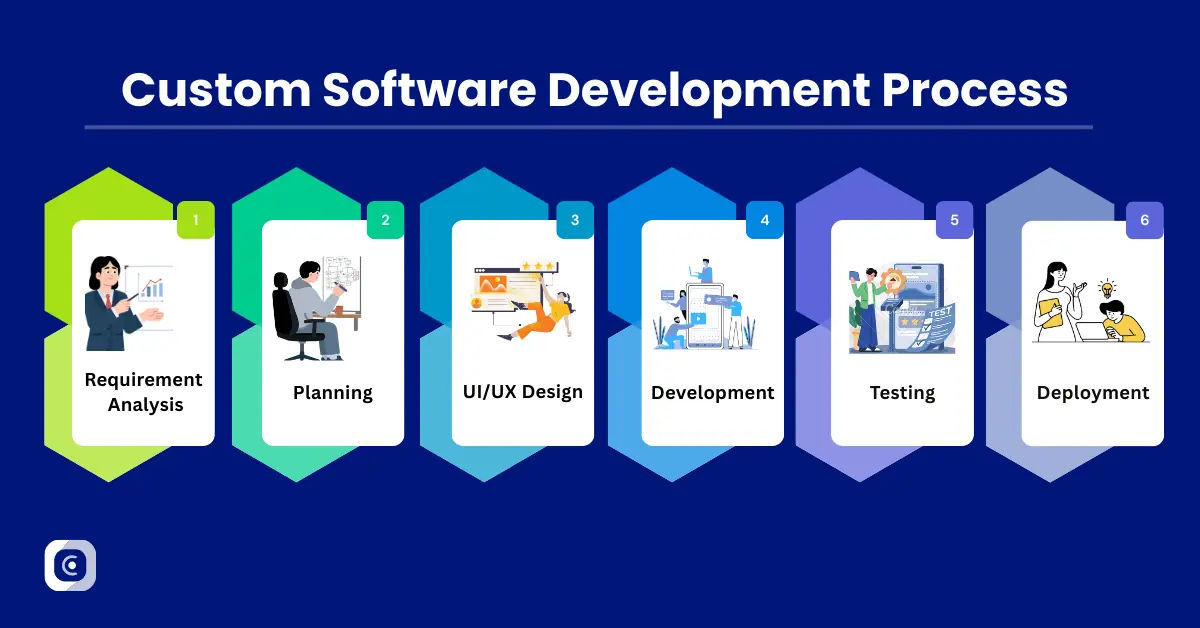
Get your hands on this easy step-by-step guide to custom software development by experts.
1. Requirement Analysis and Consultation
At the very beginning of a project, there is a series of discussions aimed at understanding the project’s direction, potential obstacles, the intended market, and the technical requirements. During this phase, the business and the custom software development service providers define the project scope, functionalities, schedules, and deliverables.
2. Planning and Strategy Formation
After the requirements have been defined, Offshore software development service providers prepare a plan that includes selecting the technology stack, system design decisions, resource allocation, cost estimation, and identification of project milestones. Good planning can go a long way in limiting risk, and orderly implementation can be expected with a reasonable level of assurance.
3. UI/UX Design and Prototyping
Designers create wireframes, mockups, and layouts for user interfaces to serve as visual guides for how the final product will function and look. The main idea is to use the software for users’ benefit, make it easy to operate, and complete the workflow efficiently before moving on to development.
4. Development and Coding
Custom software development service providers build software using approved designs and specifications. Frontend and backend development, database configuration, API integration, and feature implementation can be done using agile or iterative methods during this phase.
5. Testing and Quality Assurance
The QA team runs a variety of tests, including functional, performance, security, and debugging, to ensure the product is dependable, safe, and efficient across different setups.
6. Deployment, Support, and Maintenance
Once testing ends, the software is released for use in the production environment. The custom software development service providers continue to provide support, deliver updates, monitor performance, and add new features to ensure the product’s longevity, success, and capability to handle growth.
Software Development Cost Breakdown in 2026: Key Factors That Affect Cost
The software development cost for a business might vary widely depending on factors such as business needs, tech choices, and project complexity. A custom software development services provider that decides to build a custom, tailor-made solution internally should familiarize itself with the major price-influencing factors so that it can allocate its budget wisely and fully benefit from its investments.
1. The Work’s Intricacies and the Functionalities
Features, user roles, integrations, and workflow numbers are the main elements that directly influence the cost of development. The simplest apps cost less, but if it is enterprise-grade software with cutting-edge automation, AI, or analytics, then the development period will be longer, and a higher level of funding will be required.
2. Technology Stack Selection
The choice of programming languages, frameworks, cloud infrastructure, and third-party tools impacts not only development but also the cost of maintenance. The adoption of complex or new technologies can create a need for specialized skills, thereby increasing the overall project budget.
3. Development Team Location and Expertise
Recruiting highly skilled developers or partnering with a well-established software development company determines the price. The cost varies by location, and offshore teams can often deliver cheaper solutions than an in-house or local team in a high-cost market.
4. UI/UX Design Requirements
Highly interactive, user-friendly, and visually appealing designs require more research, prototyping, and testing. Custom user interfaces for a better user experience can raise initial costs, but will help long-term adoption and productivity.
5. Integration and Infrastructure Requirements
If a software product is to be integrated with other enterprise systems, APIs, payment gateways, or cloud platforms, it will require more development work. In addition, infrastructure setup, hosting, and security settings also add to the total cost.
| Cost Factor | Estimated Cost Range (2026) |
| Project Complexity | $10,000 – $150,000+ |
| Technology Stack | $5,000 – $40,000 |
| Team Location & Expertise | $20 – $150/hour |
| UI/UX Design | $3,000 – $25,000 |
| Integrations & Infrastructure | $5,000 – $30,000 |
Industries That Benefit from Custom Software
Healthcare
Custom software provides healthcare organizations with a more effective way to manage patient records, automate workflows, enable telemedicine services, and ensure their operations comply with regulatory requirements, leading to improved operational efficiency, patient experience, and data security for hospitals, clinics, and healthcare networks.
Finance and Banking
Financial institutions have been adapting to market changes by introducing customized solutions that address needs such as secure transactions, fraud detection, digital banking services, and compliance management, thereby enabling them to better strengthen client relationships, improve efficiency, and keep up with changes in financial regulations.
Retail and eCommerce
Retailers use custom software designed specifically for their unique scenarios to manage inventory, provide personalized shopping experiences, handle payments, and execute omnichannel operations, thereby increasing customer engagement, sales conversion, and operational efficiency while staying competitive.
Manufacturing
Manufacturers utilize custom software to address a variety of areas within their business, such as supply chain management, production planning, automation, and quality control, thereby driving more efficient resource use, reducing equipment downtime, and facilitating better decisions based on real-time data insights.
Education and eLearning
To name just a few, educational institutions are leveraging tailored software such as LMSs, virtual classrooms, and student performance monitoring systems, which not only deliver a better learning experience but also drastically reduce paperwork and enable scalable digital education solutions that meet the diverse needs of students.
Logistics and Transportation
Logistics providers offer various enterprise software development solutions that cover route planning, fleet management, real-time tracking, and warehouse automation, among other tasks, thus helping significantly reduce operational costs, increase delivery accuracy, and improve customer satisfaction throughout the entire supply chain.
Real Estate
Real estate companies are running bespoke platforms that help them manage properties, enable virtual tours, integrate CRM, and track transactions, leading to better customer engagement, more efficient workflows, and more accurate property sales and management decisions.
How to Choose the Right Software Development Company?
Choosing the right software development company is a major decision as the success, scalability, and ROI of your project depend on it. A systematic approach allows businesses to choose the right technology partner without a shadow of a doubt.
Step 1: Define Your Business Goals and Requirements
Initially, figure out what you want to achieve with your project, who will be the users, what features you need, how much you want to spend, and when you want your project to be finished. Clear requirements help set expectations and enable companies to provide accurate proposals and solutions.
Step 2: Evaluate Technical Expertise and Services
Look through the company’s technical skills, technology stack, and the sectors they have worked in. Make sure they know how to develop the type of software you want, whether web applications, mobile apps, enterprise systems, or cloud-based solutions.
Step 3: Check Portfolio and Case Studies
Look at previous works to discern the company’s suitability in terms of experience, design quality, and problem-solving strategy. Case studies reveal how the company manages difficult situations, implements solutions, and obtains tangible business results for its clients.
Step 4: Assess Client Reviews and Reputation
Check client testimonials, ratings, and third-party reviews on platforms like Clutch and Google. A company with a solid track record is likely to be reliable and professional and capable of maintaining good client relationships over time.
Step 5: Become Familiar with the Development Process and Communication
Having a clear, open development methodology, such as Agile or Scrum, means there will be a lot of flexibility and cooperation. Also, clarify how often you will receive updates, how feedback will be incorporated, and which communication tools will be used throughout the project.
Step 6: Talk about Pricing and Engagement Models
Make sure you understand the different pricing models, such as fixed cost, hourly, or dedicated team. Select an engagement model that suits not only the complexity of your project and budget but also your long-term business goals while ensuring you understand the costs clearly.
Step 7: Assess Support and Maintenance Services
Launching a product is just the beginning; it’s vital that your software remains performant and scalable. Besides that, you need to make sure the bespoke software development company can provide continuous maintenance, updates, security monitoring, and technical support to support your future growth.
Step 8: Conduct a Trial with a Small Piece of Work or Prototype
If you can, work on a pilot project or prototype to help you determine the firm’s communication, technical skills, and execution before you make a decision about the full-scale development collaboration.
Conclusion
In a nutshell, bespoke software development is a great way for enterprises to unlock new ways to enhance operational efficiency, elevate the quality of work, and gain a formidable business edge through the tailored use of digital solutions. Choosing the right development partner can be pivotal to your business scaling, securing, and achieving a good long-term return on investment. Whether you are launching a new platform or upgrading existing systems, an expert guide makes the process much faster and more successful. Drop us a line at OneClick IT Solution to learn how bespoke software can revolutionise your company’s expansion.
FAQs
What Are Custom Software Development Services?
Custom software development services encompass the entire lifecycle of software from concept through design, development, testing, deployment, and maintenance. The software is tailored to fit the business needs, workflows, and objectives, resulting in more efficient, scalable, automated, and better-performing operations.
How Much Does Custom Software Development Cost?
Custom software development costs can range from $10,000 to $150,000+. This is mostly dependent on factors such as the software’s complexity, the number of features, the technology stack, the development team’s skill level, the need for integration, and whether support and maintenance are required. For enterprise-level projects, costs can be significantly higher.
Is Custom Software Better Than SaaS?
Custom software suits businesses that require tailored features, scalability, and full control, whereas SaaS is well-suited for standard needs at a lower cost to get started. In fact, the best option depends on the company’s objectives.
How Long Does It Take To Build Custom Software?
Generally, it takes from three to nine months to develop a medium-sized custom software project, with an even longer time frame for more complex enterprise solutions. The duration of the project depends on the requirements, features, integrations, testing processes, and the size of the development team.
What Industries Need Custom Software Solutions?
Industries such as healthcare, finance, retail, manufacturing, logistics, education, and real estate benefit most from custom software, as they require specialised workflows, automation, security, and scalability to remain competitive.