 BACKEND DEVELOPMENT
 MOBILE APP DEVELOPMENT
 ADVANCE ESSENTIAL SERVICES
 ON DEMAND SOLUTION
 EMERGING TECH SOLUTION
 TRENDING TECHNOLOGY
 TRAVEL BOOKING ENGINE
 TRAVEL PORTAL DEVELOPMENT
 FRONTEND
 MOBILE
 Trending Technology
 ABOUT COMPANY
 BACKEND DEVELOPMENT
 MOBILE APP DEVELOPMENT


Amadeus vs Sabre: GDS Comparison Guide for Travel Agencies
The comparison between Amadeus vs Sabre is one of the most critical decisions for travel agencies, OTAs, and travel technology platforms looking to build scalable, competitive booking systems.
Both Amadeus and Sabre are leading Global Distribution Systems (GDS) that provide travel agencies access to real-time airline inventory, hotel bookings, car rentals, and ancillary travel services through a single integrated platform. However, they differ significantly in global coverage, API capabilities, ease of GDS integration, NDC support, and suitability for different business models.
Choosing the right GDS directly impacts how efficiently your platform handles bookings, how quickly you reach the market, and how well you scale operations over time. In simple terms:
- Amadeus known for global reach, modern REST APIs, and developer-friendly integration
- Sabre known for enterprise-grade systems, strong North American presence, and advanced booking workflows
This guide provides a detailed side-by-side comparison of Amadeus vs Sabre across inventory coverage, APIs, NDC support, pricing, and real-world use cases, everything a travel business needs to make the right GDS decision.
Amadeus vs Sabre: Quick Comparison
Before diving into the details, here is a side-by-side summary of both platforms across the most important criteria for travel businesses:
| Feature | Amadeus | Sabre |
| Founded | 1987, Madrid, Spain | 1960, Texas, USA |
| Market Focus | Europe, Asia, Global | North America, Global |
| Airline Access | 400+ airlines, 82% global flights | 420+ airlines, 150+ LCCs |
| Hotel Inventory | 650K+ unique / 2.3M options | 2M+ lodging options |
| API Technology | REST + SOAP (JSON) | REST/JSON + SOAP |
| NDC Support | 35 airlines, 26 ARM capabilities | Exclusive to 10+ carriers, 22 ARM |
| Best For | Startups, OTAs, global agencies | Enterprises, US corporate travel |
| Ease of Integration | High – developer-friendly | Moderate – requires tech expertise |
| Car Rentals | 90+ brands, 43,500 locations | 40+ brands, 40,000 locations |
| Rail Access | 25 rail operators | 9 major national rail networks, 30+ |
| Cruise Lines | 33 companies | 30+ via Traveltek |
Choose Amadeus if you want modern APIs, broader global airline coverage, and flexible integration suited for growing travel platforms.
Choose Sabre if your focus is North American markets, corporate travel, or enterprise-level booking operations requiring advanced workflow control.
What is a GDS and Why It Matters for Travel Businesses
A Global Distribution System (GDS) is a centralized technology platform that connects travel service providers such as airlines, hotels, car rental companies, and cruise operators with travel agencies, OTAs, and booking platforms in real time.
For a travel agency or OTA, a GDS eliminates the need to integrate hundreds of individual suppliers. Instead, a single GDS connection gives access to:
- Real-time seat availability and flight pricing from 400+ airlines
- Live hotel inventory from millions of properties worldwide
- Car rental, rail, cruise, and ancillary services in one place
- Automated booking, ticketing, and itinerary management
Beyond bookings, a GDS acts as the backbone of a travel technology platform enabling automation, global distribution, and the scalability needed to compete in today’s online travel market. The three dominant GDS platforms globally are Amadeus, Sabre, and Travelport, collectively handling over 97% of GDS bookings worldwide.
Amadeus vs Sabre Overview: Understanding Both Platforms
What is Amadeus GDS?
Amadeus is a globally established GDS platform founded in 1987 in Madrid, Spain, by four major European airlines – Air France, Lufthansa, Iberia, and SAS. Today it operates across 190 markets with over 100 offices worldwide, serving more than 55,000 travel sellers.
Amadeus dominates markets in Europe, Asia-Pacific, the Middle East, and Africa. Its modern API ecosystem with both self-service APIs for startups and enterprise solutions for large travel businesses makes it a preferred choice for OTAs, travel aggregators, and fast-growing booking platforms.
Amadeus is widely used for building:
- Online travel agencies (OTAs)
- B2B and B2C travel portals
- Flight booking engines
- Travel aggregator platforms
- Hotel reservation systems
What is Sabre GDS?
Sabre is a US-based Global Distribution System that originated as a computer reservation system developed by American Airlines in the 1960s. Headquartered in Texas with offices in 30 countries, Sabre connects more than 400,000 travel agencies across 160 countries.
Sabre’s strength lies in its dominant North American presence and enterprise-grade booking capabilities. It is purpose-built for high-volume, structured travel operations requiring reliability, deep workflow control, and complex booking logic.
Sabre is widely used by:
- Corporate travel management companies (TMCs)
- Enterprise-level travel agencies
- Airlines for passenger service systems (SabreSonic PSS)
- Large-scale booking platforms targeting the US market
Key Differences Between Amadeus and Sabre You Should Know
Market Reach and Global Presence
Amadeus has the widest global footprint of any GDS, operating across 190 markets including strong penetration in Europe, Asia, the Middle East, and Africa. For travel platforms targeting international travelers, Amadeus offers broader airline partnerships and deeper distribution infrastructure globally.
Sabre, on the other hand, dominates North America and has a strong presence in Latin America. While it has expanded internationally, its ecosystem is deeply tied to US-based airlines, corporate travel programs, and the American market.
Business implication: Platforms targeting global travelers or European/Asian markets benefit from Amadeus. Agencies focused on North American corporate travel or US airline content will find Sabre’s regional depth more advantageous.
Inventory Access and Travel Content
Both platforms provide access to 400+ airlines, but differ in structure and depth. Amadeus consolidates over 400 airlines including 130+ low-cost carriers (LCCs) such as Ryanair, covering approximately 82% of global scheduled flights. Its hotel inventory spans 650,000+ unique properties with 2.3 million total lodging options, including major chains like Marriott, IHG, and Accor.
Sabre connects to 420+ airlines both full-service and 150+ LCCs, with its own passenger service system, SabreSonic. Its hotel inventory is larger numerically with 2 million+ lodging options, and it holds a key partnership with Hyatt Hotels as their central reservation system provider from 2024.
Business implication: Amadeus offers better global airline diversity and alternative accommodation access. Sabre holds advantages in hotel inventory volume and US hotel chain partnerships.
Ease of Integration and Developer Experience
Amadeus provides a dedicated developer portal (Amadeus for Developers) with well-documented REST APIs, sandbox environments, and a self-service tier that allows startups to build and test without a full enterprise contract. This significantly reduces development friction and time-to-market.
Sabre offers the Dev Studio platform with both REST and SOAP APIs, but integration typically requires deeper technical expertise and structured implementation processes. Its orchestrated APIs which combine multiple operations into a single API call offer efficiency benefits for complex booking workflows.
Business implication: For startups and mid-sized agencies, Amadeus reduces integration time and cost. For enterprises with dedicated tech teams, Sabre’s advanced API orchestration provides greater operational control.
Amadeus vs Sabre NDC Comparison: The Future of Airline Distribution
New Distribution Capability (NDC) is transforming how airline content is sold globally. Led by IATA, NDC allows airlines to offer richer, personalized content including dynamic pricing, bundled offers, and ancillaries directly through GDS channels rather than through legacy EDIFACT protocols.
Both Amadeus and Sabre support NDC, but with different strategies:
| Criteria | Amadeus NDC | Sabre NDC |
| NDC Airlines | 35 airlines, 165 countries | Exclusive access to ANA, Turkish, Aeromexico + others |
| ARM Capabilities | 26 (sellers), 37 (airlines in Altéa) | 22 (sellers), 18 (airlines) |
| API Format | XML SOAP (stable, standardized) | REST/JSON (modern, web-native) |
| NDC Strategy | Broader airline network & scale | Flexible, deep airline partnerships |
| Best For | Wide NDC airline access globally | Modern API stack + specific airline exclusivity |
Amadeus NDC Strategy
Amadeus has the broadest NDC airline network of any GDS, with 35 airlines covering 165 countries. It includes major carriers like Air France-KLM, United Airlines, Singapore Airlines, Iberia, Qantas, and American Airlines. Amadeus uses XML-based SOAP APIs for NDC content, which are robust and widely adopted across the industry.
Amadeus supports 26 ARM (Airline Retailing Maturity) capabilities for sellers and 37 for airlines using Altéa Reservation the highest airline-side ARM coverage among all three major GDSs.
Sabre NDC Strategy
Sabre takes a focused approach offering exclusive NDC access to carriers not available on other GDSs, including ANA (Japan’s largest airline), Turkish Airlines, Aeromexico, WestJet, and the full LATAM group. This gives Sabre a unique competitive advantage for agencies heavily booking with these carriers.
Sabre’s NDC implementation uses modern REST/JSON Offer and Order APIs, a more web-native approach that many development teams prefer for new integrations. It supports 22 ARM capabilities for sellers and 18 for airlines.
Key takeaway: If your agency needs the widest NDC airline network globally, Amadeus leads. If your bookings are concentrated on Sabre-exclusive NDC airlines (LATAM, ANA, Turkish), Sabre is the only GDS option for those carriers.
Amadeus vs Sabre API Comparison: Technology and Scalability
API capabilities are central to how a travel platform operates, scales, and connects with airline and hotel suppliers. Here is a direct comparison of both GDS API ecosystems:
| Capability | Amadeus API | Sabre API |
| API Format | REST + SOAP, JSON | REST/JSON + SOAP |
| Flight Booking | Flight Search, Pricing, Booking APIs | Air Shopping, Booking, Fulfillment APIs |
| Hotel Booking | Hotel Search, Availability, Booking | Hotel Shop, Book, Modify APIs |
| NDC API | XML SOAP + Selling Platform Connect | REST/JSON Offer & Order APIs |
| Orchestration | Modular – combine as needed | Orchestrated APIs (multi-step in 1 call) |
| Access Tiers | Self-Service (startups) & Enterprise | Unified Dev Studio |
| Ancillaries | Seat, baggage, fare families | Branded fares, ancillaries, upgrades |
| Best For | Fast integration, modern stack | Complex workflows, enterprise ops |
Amadeus API Capabilities
Amadeus offers a modular API ecosystem built on modern REST architecture with JSON data exchange. It is organized into two tiers:
- Self-Service APIs: Available to any developer via the Amadeus for Developers portal with sandbox access, no sales process required. Ideal for startups and early-stage platforms.
- Enterprise APIs: Full commercial access with 24/7 dedicated support, a larger API catalog, and SLA guarantees. Designed for established travel businesses.
Key Amadeus APIs for travel platforms include:
- Flight Search, Pricing, and Booking APIs
- Hotel Search, Availability, and Booking APIs
- Car Rental and Transfer APIs
- Destination Experience and Activities APIs
- Travel Insights and Demand Forecasting APIs
- NDC Content APIs via Selling Platform Connect
Sabre API Capabilities
Sabre’s API ecosystem accessible through Sabre Dev Studio blends REST and SOAP technologies, offering both modern web-native APIs and legacy compatibility for established travel systems.
Its key differentiator is orchestrated APIs, which bundle multiple booking operations (search, price, book, seat, ancillary) into a single API call. This significantly reduces latency and backend complexity for high-volume platforms.
Key Sabre APIs for travel platforms include:
- Air Shopping, Booking, and Fulfillment APIs
- Hotel Shopping and Reservation APIs
- Car Rental and Rail Booking APIs
- Cruise and Tour Operator APIs
- NDC Offer and Order APIs (REST/JSON)
- Loyalty and Itinerary Management APIs
Amadeus vs Sabre: GDS Software Tools for Travel Agencies
Both GDS platforms offer pre-built software tools for travel agencies, TMCs, and online booking systems beyond just API access:
Amadeus Selling Platform Connect
A cloud-based agent desktop that allows travel agents to search, book, and manage travel from any device with internet access. It provides automated updates, a modern interface, and integrates with Amadeus’ full content catalog. Over 300,000 agents across 200 markets use it daily.
Sabre Red 360
Sabre’s agent desktop that connects travel agents to a broad range of airline, hotel, and ancillary content. It integrates carbon offset data for sustainability-conscious agencies and includes Red Apps a marketplace of third-party plugins that extend booking capabilities without custom development.
Corporate Travel Management Tools
- Amadeus Cytric Travel & Expense: An end-to-end corporate travel and expense management suite with mobile app, CO2 compensation reports, and integration with ERP systems.
- Sabre GetThere: A cloud-based online booking tool widely adopted by global corporations for managing travel policies, approvals, and reporting across all device types.
B2B Payment Platforms
- Amadeus Outpayce: A B2B payments platform for virtual card issuance and supplier payments, connected to 50+ card issuers worldwide.
- Sabre Conferma Pay: Acquired in 2022, this platform connects travel businesses to 50+ banks and supports virtual credit cards in 100 currencies globally.
GDS Pricing and Implementation Considerations
Both Amadeus and Sabre operate on a customized, quote-based pricing model meaning neither publishes fixed pricing. Costs are determined based on specific business requirements, and the best approach is to contact each GDS provider directly.
Factors That Influence GDS Pricing
- Booking volume: higher transaction volumes affect per-booking costs
- Geographic coverage: market-specific access may carry separate fees
- Content type: airline-only vs full multi-supplier content
- API tier: self-service vs enterprise contracts
- Negotiated supplier deals: preferential rates can offset GDS booking fees
Implementation Timeline
Basic API integrations can be completed within a few weeks for standard use cases. Enterprise-level GDS implementations involving custom booking workflows, NDC certification, and full content integration typically require 2 to 4 months depending on platform complexity.
Both Amadeus and Sabre require a certification process before production access is granted. Factor this into your project timeline when evaluating which GDS to integrate first.
Pro tip: Working with a certified GDS integration partner like OneClick IT Consultancy can significantly reduce your implementation timeline and navigate the certification process efficiently.
Which GDS is Better for Your Travel Business
The right GDS depends on your business model, target geography, booking volume, and technical capabilities. Here is a clear breakdown:
Choose Amadeus If Your Business:
- Targets global travelers, European, Asian, or Middle Eastern markets
- Is a startup or growing OTA looking for fast, developer-friendly API integration
- Needs the broadest NDC airline network globally
- Builds diverse travel products like flights, hotels, activities, rail, insurance
- Wants a modular API approach with scalability from day one
Amadeus is ideal for startups, OTAs, and platforms building modern travel solutions targeting international markets.
Choose Sabre If Your Business:
- Is focused on North American markets or corporate travel programs
- Requires enterprise-level booking workflows with high operational control
- Needs exclusive NDC access to LATAM airlines, ANA, Turkish Airlines, or Aeromexico
- Has a technical team capable of handling SOAP + REST API orchestration
- Manages high-volume transactions requiring workflow optimization
Sabre is the right choice for corporate travel companies, enterprise TMCs, and large-scale booking platforms targeting the Americas.
Accessing GDS Travel Systems: A Guide to Integration
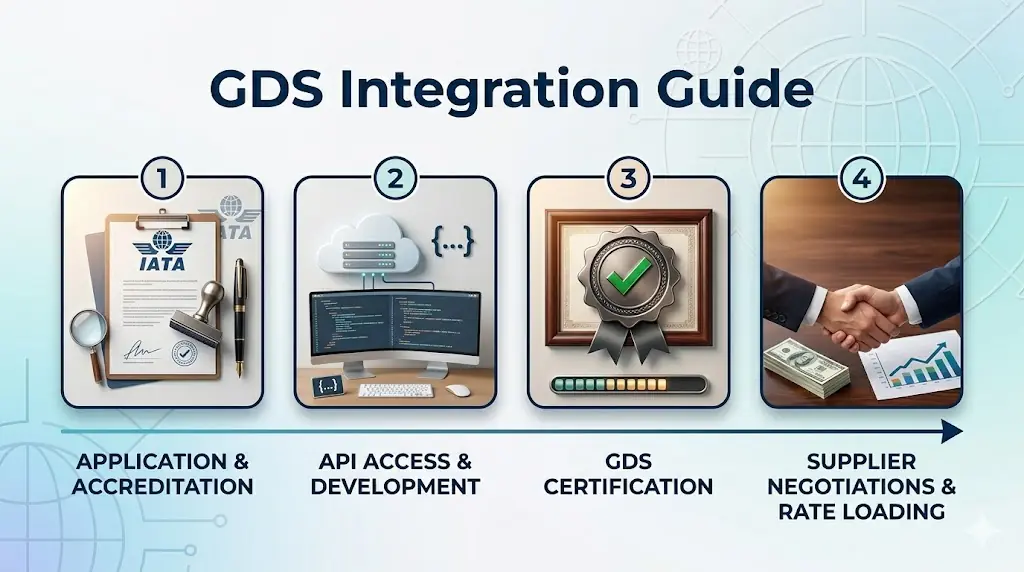
Getting started with Amadeus or Sabre GDS integration involves several steps that travel businesses need to plan for:
Step 1: Application and Accreditation
Contact Amadeus or Sabre directly to begin the application process. Travel agencies handling air ticketing typically need IATA accreditation (or ARC/IATAN numbers in the US). Smaller agencies may partner with a host agency or air consolidator as an alternative pathway.
Step 2: API Access and Development
Once approved, you receive API credentials and documentation access. Amadeus provides immediate sandbox access through its developer portal. Sabre grants access through Dev Studio after account setup. Development involves building API connections, testing booking flows, and preparing for certification.
Step 3: GDS Certification
Before going live in production, both GDS platforms require certification — a process that validates your integration against their technical standards. This typically takes 2 to 6 weeks depending on the scope of your integration and platform complexity.
Step 4: Supplier Negotiations and Rate Loading
To maximize GDS value, travel agencies should negotiate preferential rates with suppliers. Once agreed, these rates are loaded into the GDS and made available automatically to your booking platform giving customers access to contracted pricing without manual management.
Why Work With a GDS Integration Partner?
GDS integration involves API development, certification requirements, NDC configuration, and ongoing supplier management. Working with an experienced travel technology partner reduces implementation risk, accelerates go-live, and ensures your platform is built to scale.
Exploring Alternatives to GDS for Travel Distribution
While GDS platforms are the standard for comprehensive travel distribution, there are alternative distribution channels worth considering depending on your business model:
Large Online Travel Agencies (OTAs)
Expedia Partner Solutions and Booking.com Affiliate Program offer direct hotel and accommodation inventory through REST APIs, suitable for businesses focused primarily on hotel bookings without airline distribution needs.
Wholesalers and Bed Banks
Bed banks like Hotelbeds provide large hotel inventories at contracted rates often used by OTAs and tour operators. They offer APIs and direct connectivity, and serve as a cost-effective alternative for businesses focused on accommodation-heavy travel products.
Direct Provider Connections
Some airlines and hotel groups now offer direct API connectivity for high-volume partners, bypassing GDS fees. NDC-enabled direct connections are increasingly available from major carriers like Lufthansa, British Airways, and American Airlines though managing multiple direct integrations adds significant technical complexity compared to a single GDS connection.
Amadeus vs Sabre: Determining the Best Airline GDS System
Amadeus and Sabre are both world-class GDS platforms, but they serve different travel business needs. The right choice is not about which platform is universally better, instead it is about which one aligns with your specific target market, booking volume, technical capabilities, and growth strategy.
- Amadeus leads for global reach, developer-friendly integration, modern APIs, and the widest NDC airline network.
- Sabre leads for North American markets, enterprise workflow control, and exclusive NDC partnerships with key carriers.
For travel businesses grappling with GDS selection, API integration complexity, or custom booking platform development, partnering with a specialized travel technology consultancy removes the guesswork and accelerates your time-to-market.
Frequently Asked Questions: Amadeus vs Sabre
Is Amadeus better than Sabre for travel agencies?
It depends on your market focus. Amadeus is generally better for agencies targeting global or European markets, OTAs, and startups needing fast integration. Sabre is stronger for North American corporate travel and enterprise operations requiring advanced booking workflows.
Which GDS has more hotels Amadeus or Sabre?
Sabre has a larger hotel inventory numerically with 2 million+ lodging options. Amadeus provides 2.3 million total options across 650,000+ unique properties, with an edge in alternative accommodations through aggregator partnerships.
Does Sabre support NDC?
Yes. Sabre supports NDC through REST/JSON Offer and Order APIs, with exclusive NDC access to carriers like ANA, Turkish Airlines, Aeromexico, and the LATAM group, airlines not available on any other GDS for NDC content.
How long does GDS API integration take?
Basic integrations can go live within 2 to 6 weeks. Full enterprise implementations with NDC, custom workflows, and multi-supplier content typically take 2 to 4 months, including certification time.
Which GDS is better for small travel agencies?
Amadeus is generally more accessible for smaller agencies thanks to its self-service API tier, extensive documentation, and sandbox environment all accessible without a large upfront enterprise commitment.
Can I integrate both Amadeus and Sabre?
Yes. Some large travel platforms integrate multiple GDS providers for content redundancy and to access exclusive airline inventory across both systems. However, this increases integration complexity and ongoing maintenance. Most businesses start with one GDS and expand later.