
 BACKEND DEVELOPMENT
 MOBILE APP DEVELOPMENT
 ADVANCE ESSENTIAL SERVICES
 ON DEMAND SOLUTION
 EMERGING TECH SOLUTION
 TRENDING TECHNOLOGY
 TRAVEL BOOKING ENGINE
 TRAVEL PORTAL DEVELOPMENT
 FRONTEND
 MOBILE
 Trending Technology
 ABOUT COMPANY
 BACKEND DEVELOPMENT
 MOBILE APP DEVELOPMENT


AI Development Services: A Complete Guide for Enterprises
Today, businesses have less room for inefficiency as they seek to reduce operational costs and deliver excellent customer experiences. Advanced technology solutions help enterprises achieve these goals more efficiently. They enable smarter workflows, faster analysis of complex data, and better decision-making. AI development services focus on creating custom solutions that support automation, forecasting, personalization, and departmental optimization. Regardless of the sector, such as healthcare, finance, retail, or manufacturing, businesses are adopting intelligent systems to gain a competitive advantage. However, for the implementation to be successful, there needs to be a blueprint, skilled workers, and the right tools. This guide describes the operation of these solutions, their application areas, and the methods enterprises can use to implement them successfully.
What Is AI Application Development?
AI application development involves creating software that uses data and algorithms to perform tasks that typically require human judgment. Such applications can simplify workflows, analyze massive datasets, deliver tailored experiences, and improve operational efficiency. AI application development usually includes stages such as planning, data preparation, model building, testing, deployment, and continuous improvement.
AI vs Machine Learning: Key Differences
Artificial Intelligence and Machine Learning are closely related technologies but differ in scope, functionality, and implementation. Understanding their key differences helps businesses choose the right approach for automation, data analysis, and decision-making needs.
| Basis | Broader Concept | Learning-Focused Approach |
| Scope | Focuses on building systems that can think, reason, and make decisions just like humans in a wide range of situations. | A subfield of artificial intelligence that specifically focuses on machines being able to learn from the pattern of the data and automatically getting better over time. |
| Functionality | May implement industry standards, rules, or logical ways to break down and solve problems. | Learning-based systems rely on algorithms that analyze patterns in data and improve performance through training. |
| Data Dependency | It programmed logic and conditions are followed when making decisions, it can work with little data. | Needs a huge volume of data to be accurate, and the more data the better the performance. |
| Learning Capability | For the most part, any changes need to be made manually or the developers have to change the rules. | Systems change on their own by getting knowledge from fresh data, thus no need for human intervention all the time. |
| Implementation Complexity | To some extent, it is more straightforward to create rules and processes for structured problems. | Takes more effort because it involves the preparation of data, training, validation, and continuous optimization. |
| Applications | Examples include automation platforms, smart assistants, robotic systems and intelligent decision-support tools. | This technology is typically employed in scenarios like forecasting, recommendation systems, fraud detection, speech recognition and image analysis. |
| Primary Goal | The branch of AI that focuses on machines getting the ability to imitate intelligent behavior and decision-making that humans possess. | It is a major tool for attaining intelligence in machines by learning from the data directly. |
Business Use Cases of AI in 2026
Businesses in 2026 are heavily investing in complex, intelligent systems to become more efficient, improve the customer experience, and introduce more innovative products and services. They are using Robotics, Machine Learning, AI, and many other technologies, with their operations impacted to varying degrees across divisions, sectors, and industries.
1. Automating Customer Service
Businesses are installing intelligent conversational agents and virtual assistants that aid customers during interactions for clarification and complaint resolution, and provide access to services 24/7. Shorter response times, lower customer service costs, and higher customer satisfaction resulting from fast, accurate communication are among the benefits.
2. Sales Prediction and Demand Forecasting
With big data analytics, companies can gain valuable insights into customer demand, buying patterns, and market trends. Such insight enables the company to effectively manage stock, run highly targeted marketing campaigns, and improve its revenue forecast, thereby allowing it to make decisions proactively.
3. Detecting and Preventing Fraud
Financial companies and other businesses that handle large amounts of money use technologies that analyze past transactions to first understand what normal transactions look like and then detect anomalies that could indicate fraud. This way, they are able to identify fraud and manage their risk exposure in a much more efficient way. Such NLP solutions can process large transaction datasets at high speed, reducing the need for human monitoring.
4. Personalized Customer Experiences
Understanding user preferences, behaviors, and previous purchases enables a company to personalize customer experiences at a deeper level with product recommendations, content, and marketing messages. Customer-brand engagement increases, sales lead to higher conversion rates, and the consumer-brand relationship is further strengthened through a customer-centric brand experience.
5. Process Automation and Operational Efficiency
Businesses adopt software solutions that automate routine, repetitive tasks such as data entry, document handling, and workflow management. This not only reduces the number of human errors, increases overall output, and allows employees to dedicate more time to higher-level business activities, but also enables staff to engage in more value-adding tasks.
6. Healthcare Diagnosis and Treatment Support
Healthcare providers who are harnessing the power of advanced devices and software to glean invaluable clinical insights from patients’ medical records, x-rays, and other data to support accurate diagnosis and treatment decisions. This increases the accuracy and speed of decision-making and ultimately, through data insights, leads to better patient management and outcomes.
Generative AI vs Traditional AI
It is important to grasp the distinction between generative systems and traditional AI solutions if a business is to successfully benefit from advanced technologies. Essentially, each method has a different purpose, set of capabilities, and intended results, and choosing the most appropriate one can be a key factor in achieving success.
1. Core Purpose
Generative AI refers to computer programs that understand existing data patterns and use them to create entirely new content, such as text, images, music, or code. Traditional systems mostly just analyze data, identify types, or make decisions based on the instructions or rules they have been given or the patterns they have learnt.
2. Output Type
Generative models make products from scratch that previously did not exist, such as articles or artworks. Conventional methods generally produce predictions, suggestions, or decisions rather than entirely new material.
3. Learning Approach
Generative methods capture complex patterns and structures in data and use them creatively. Conventional methods usually use structured data, statistical analysis, or rule-based programming to address issues or tasks.
4. Complexity and Computing Needs
Generative technologies generally need much more computing power, massive datasets, and sophisticated infrastructures. Traditional systems are usually less resource-intensive and easier to handle for single business tasks.
5. Business Applications
Popular application areas of generative AI include content creation, product design, virtual assistants, and automation of artistic processes. Traditional approaches are most often used in fraud detection, recommendation systems, forecasting, and process optimization.
6. Flexibility and Adaptability
Generative systems are considered more adaptable because they can handle open-ended tasks and produce diverse outputs. Conventional systems are often set up to carry out predetermined operational functions with measurable outputs. Hence, such systems tend to have higher levels of predictability, but at the same time, they lack the attribute of versatility or adaptability.
AI Development Process Explained
Building intelligent software requires a structured approach to ensure accuracy, efficiency, and scalability. Understanding each development stage helps businesses plan better, reduce risks, and successfully implement advanced technology solutions aligned with operational goals.
1. Requirement Analysis and Business Understanding
The initial stage involves gaining deep insight into the company’s goals, obstacles, and anticipated results. The AI development services work closely with various stakeholders to define use cases, assess data availability, determine technical requirements, and establish success metrics, ensuring the solution aligns with corporate goals and delivers measurable value.
2. Data Collection and Preparation
After the requirements are finalized, data relevant to the business is obtained from multiple sources, such as databases, user interactions, or operational systems. Subsequently, this data undergoes cleaning and is organized and prepared to be high-quality, consistent, and usable for creating trustworthy, intelligent models.
3. Solution Design and Architecture Planning
The professionals architect the system’s overall design, select the most suitable technologies, and establish the methods of work. Among other things, this phase entails deciding on the algorithms to be used, integration methods, infrastructure requirements, and scalability considerations, to ensure the solution can deliver in real-world business situations.
4. Model Development and Training
The machine learning development company uses prepared datasets to train and build models. Several rounds of testing are conducted; for example, the models’ performance, accuracy, and reliability improve after each round. In this stage, different techniques might be tested to determine which best serves the business needs.
5. Testing, Validation, and Integration
After the solution is developed, it is subjected to thorough examination to check its accuracy, security, and performance. Once it is cleared, it will be embedded into the business systems, applications, or workflows that are already in place, ensuring the integration works perfectly without disrupting operations.
6. Deployment, Monitoring, and Continuous Improvement
Once the testing phase went well, the solution was moved to the production environment. The performance is being tracked via continuous monitoring, which also helps in issue identification and the discovery of improvement opportunities. In this case, the system is always updated and refined in order to stay effective, even as business needs change over time.
Benefits of AI for Business Growth
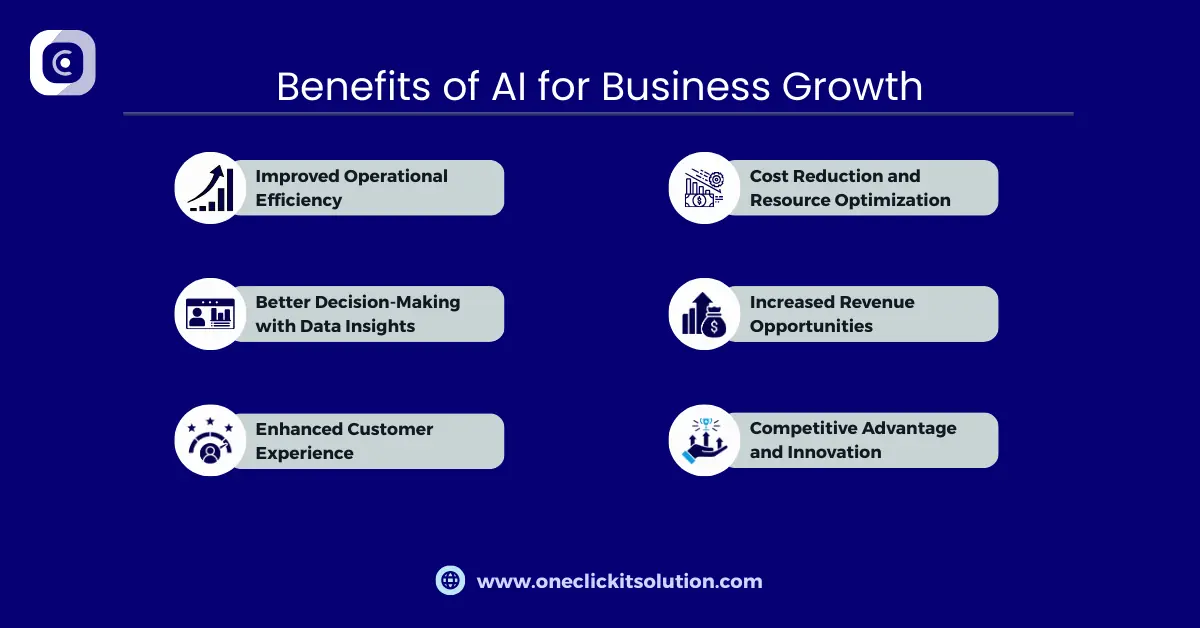
Modern businesses are adopting advanced technologies to improve efficiency, reduce costs, and enhance customer experiences. These innovations help organizations streamline operations, make smarter decisions, and access new growth opportunities across.
1. Improved Operational Efficiency
Where there are advanced systems, they can be used for automating repetitive and very labor-intensive tasks such as data processing, responding to customers, and managing the work. As a result, there will be less manual labor, fewer mistakes, and employees will be free to concentrate on strategic initiatives that bring about business growth and innovation.
2. Better Decision-Making with Data Insights
It is possible for organizations to quickly analyze a huge amount of data to find patterns, trends, and opportunities. Such insights enable executives to make more informed choices, lower the level of unfamiliarity, and be better prepared when unforeseen situations arise, such as market fluctuations, changes in customer behavior, and operational problems.
3. Enhanced Customer Experience
By utilizing customer data, companies gain the ability to offer personalized recommendations, quicker responses, and customize the services accordingly. Higher customer satisfaction also leads to stronger brand loyalty and more frequent purchasing behavior, all of which are factors that drive the growth of revenue in the long run.
4. Cost Reduction and Resource Optimization
By means of automation and predictive analysis, companies are enabled to save on operational costs through better resource usage, less waste, and the avoidance of costly errors. The latter allows companies to achieve higher levels of efficiency while sustaining low operational costs, thus, they are able to increase their overall profitability.
5. Increased Revenue Opportunities
Through applying advanced analytics and smart suggestions, people involved in sales can identify product offers that are most likely to bring success, set optimal prices, and come up with accurate projections of sales performance. Therefore, firms can offer their products or services to the most suitable customers, which results in more orders, and, at the same time, profit generation is also on the rise.
6. Competitive Advantage and Innovation
Organizations that embrace a digital transformation make a leap forward in the market by providing more intelligent products and services and managing their operations more efficiently and effectively. Through regular innovation, companies are able to respond to changes in the market and thus continue to be the leader of their industry even in rapidly changing conditions.
How to Choose an AI Development Company?
1. Define Your Business Goals Clearly
Determining your business challenges, expected outcomes, and use cases prior to engaging a predictive analytics services provider is a prudent approach. Having well-defined objectives allows you to determine if a company really understands your vision and if its technical approach is aligned with your needs. It is a step that additionally stops unnecessary expenses and scope misunderstanding during development. If you’re still defining those goals, our AI consulting services can help you build that clarity before development begins.
2. Evaluate Technical Expertise and Experience
Analyze the company’s proficiency in advanced technologies, tools, and frameworks. Apart from that, you can look for their experiences in similar projects, industries, and types of solutions. A good portfolio, case studies, and technical knowledge are indicators of their capacity to provide dependable and scalable solutions that are customized to your needs.
3. Assess Industry Knowledge
There is a big advantage to choosing a company that knows your industry well. Team developers with knowledge of the industry can easily understand workflows, compliance requirements, and user expectations. Hence, it helps to reduce the learning curve and increases the chances of developing a solution that really adds business value.
4. Check Development Approach and Methodology
Get to know how the company handles projects, for example, how they plan, communicate, test, and deliver within the set time. Having a well-organized development method along with weekly updates, milestone tracking, and clear reporting will allow you to work together more effectively and have better control of the project’s progress.
5. Review Data Security and Compliance Practices
Intelligent systems are data-driven, so security is vitally important. You should assess the AI software development company’s policies regarding data protection, encryption, compliance standards, and confidentiality agreements. A reliable partner must implement security measures at each stage of development and deployment.
6. Consider Scalability and Support Services
Your business will change, and so should your solution. Check if the company is capable of creating scalable architecture and also offering continual maintenance, monitoring, and optimization support. Services after deployment are necessary for the long run when it comes to performance, updates, and the changing requirements of the business.
7. Compare Pricing and Engagement Models
Cost needs to be considered along with value, and not be the only factor determining a decision. Look at pricing structures, engagement models, and deliverables when comparing various companies. Pick a partner that is transparent, flexible, and provides a combination of affordability and quality, so that you can get the most out of your investment.
Conclusion
Cutting-edge tech solutions are revolutionizing the way businesses conduct their operations by lowering costs, helping managers make better decisions, and increasing customer engagement levels. If businesses combine a good plan with skilled personnel and a dependable generative AI development partner, they can become innovative and grow sustainably. An investment in smart technologies made today will help a business remain competitive, respond to market changes, and establish operations that are ready for the future in a world that is getting more and more digital.
FAQs
What Are AI Development Services?
AI development services basically refer to the creation of smart software solutions that can help a business automate its processes, take advantage of the gathered data, make better decisions, or even offer users a better experience using high-tech equipment and tools that are made to meet the specific needs, requirements, and goals of a business.
How Much Does AI Development Cost?
The price of AI development services varies greatly depending on the complexity of the project, the different features involved, the amount of data required, the level of integration needed, and the length of the development process. A small-scale project might cost only a few thousand dollars, whereas in the case of an enterprise-level solution, one can expect a very high long-term investment and a lot of resources being used.
What Industries Use AI Solutions?
AI technologies have found their way into a lot of industries, such as health, finance, retail, manufacturing, logistics, education, and entertainment. Companies deploy such technologies in order to increase their efficiency, enhance their customers’ experience, improve the accuracy of their forecasts, and facilitate their operational and strategic decision-making at all stages.
What Is The Difference Between AI And ML?
AI is often used to describe larger systems that simulate human intelligence to carry out tasks, whereas machine learning is one of the subsets of AI that allows the systems to identify patterns in data and learn on their own to improve performance without being explicitly programmed.
Is AI Secure For Enterprise Applications?
In case of a strong commitment to keeping data safe, incorporating encryption, access controls, and compliance as measures of the security steps taken, AI can be secure for enterprise applications. In fact, security is also affected by the use of proper monitoring and risk management tools, as well as performing system updates regularly.