
AI/ML
Kimi K1.5 vs ChatGPT: Which AI Model Performs Better?
Kimi K1.5 Model for your Business?

Cost Efficiency (Open Source)
Lower Long Term costs
Customised data control
Pre-trained model
Introduction
Artificial intelligence models are evolving rapidly, and two leading names in this space are Kimi K1.5, developed by Moonshot AI, and ChatGPT, developed by OpenAI. Each model has unique strengths, performance traits, and ideal use cases. Understanding how they compare helps businesses, developers, and innovators choose the right AI model for their needs.
This comparison explores Kimi K1.5 vs ChatGPT across performance, natural language understanding, coding support, creativity, multilingual capability, and industry use cases. It also highlights where each model excels and which scenarios favor one over the other.
Overview of Kimi K1.5 and ChatGPT
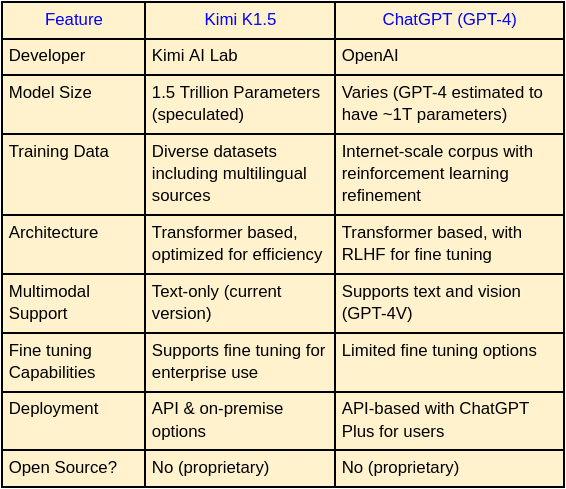
Kimi K1.5 is part of the advanced AI model suite from Moonshot AI. It is designed for strong reasoning, structured responses, and advanced context handling. The model uses long-context capabilities and reinforcement learning techniques, allowing it to process and reason over extensive content.
ChatGPT, especially in its later iterations like GPT-4 and beyond, is known for versatility, creativity, and extensive language support. It delivers robust conversational skills, nuanced understanding, and an intuitive interaction experience across multiple domains.
Natural Language Understanding
When it comes to general comprehension and contextual awareness, both models perform strongly but with different strengths:
Kimi K1.5: Excels in structured comprehension and detailed reasoning tasks, making it suitable for enterprise documentation, technical applications, and scenario logic where strict accuracy matters.
ChatGPT: Offers broader conversational understanding, handling nuanced dialogues, questions, and multi-turn interactions with natural fluency. It tends to generate responses that feel more human and engaging.
Best for:
- Technical, structured content: Kimi K1.5
- Conversational, nuance-rich interactions: ChatGPT
Response Quality and Creativity
ChatGPT is widely recognized for producing creative, elaborate, and engaging responses. It is effective for storytelling, ideation, and expressive text generation, making it a good choice for marketing, content creation, and user-facing interactions.
Kimi K1.5, on the other hand, generates responses that are concise, direct, and optimized for clarity and factual accuracy. This makes it well-suited for analytical tasks, reporting, and structured outputs.
Coding Support and Technical Assistance
Both AI models support programming and development tasks, but with subtle differences:
ChatGPT: Known for strong code explanation, debugging, optimization, and structured walkthroughs. It supports multiple coding languages and frameworks, and its outputs include clear explanations.
Kimi K1.5: Capable of generating structured code snippets and strong reasoning for complex logic, but may be less flexible in deep debugging or iterative refinement.
Best for developers:
- Code explanations and debugging: ChatGPT
- Automated code generation with structured requirements: Kimi K1.5
Multilingual Support
ChatGPT has been extensively tested and fine-tuned for a wide range of languages, making it widely usable across global applications. Kimi K1.5 provides multilingual support but is currently more optimized for high-resource languages.
Best for global applications: ChatGPT
Use Case Suitability
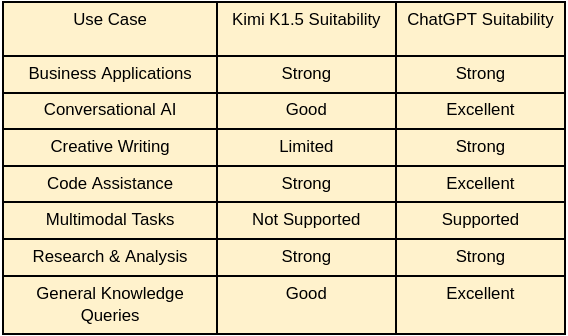
Enterprise Documentation and Knowledge Systems
Kimi K1.5 performs exceptionally well for enterprise contexts that require precise, structured, and factual outputs such as policy documentation, SOPs, compliance manuals, and internal knowledge bases.
Creative Content and Branding
ChatGPT is typically superior for creative content generation, including blogs, social media messaging, storytelling, and brand engagement content.
Customer Support and Chatbot Experience
Both models can power customer support systems, but with different strengths:
Kimi K1.5: Best for rule-based responses, repetitive FAQs, and backend automation.
ChatGPT: Stronger for empathetic conversational flows, dynamic responses, and multi-language support.
Research Summaries and Data Analysis
Kimi K1.5 is particularly good at structured analysis, summarization, and technical insight extraction from long documents, thanks to its internal reasoning focus.
Ethical Considerations, Bias, and Safety
Both models incorporate responsible AI principles, but their moderation and safety mechanisms differ:
- ChatGPT: Benefits from rigorous reinforcement learning fine-tuning and safety guardrails to minimize harmful or biased outputs.
- Kimi K1.5: Offers flexibility with fewer constraints, which can be advantageous for structured tasks but may require oversight depending on sensitive use cases.
Conclusion: Which Model Is Right for You?
Kimi K1.5 and ChatGPT are powerful AI systems with distinct strengths:
Choose Kimi K1.5 for enterprise-level structured reasoning, technical documentation, precise outputs, and analytical tasks.
Choose ChatGPT when creativity, conversational quality, multilingual capabilities, and customer-facing interactions are priority.
The choice ultimately depends on your project goals, the type of content or interaction you need, and the balance between factual precision and creative flexibility.
Whether you require advanced reasoning, technical generation, or conversational fluency, understanding these differences helps you select the right AI model for 2026 and beyond.
Ready to transform your business with our technology solutions? Contact Us today to Leverage Our AI/ML Expertise.


AI/ML
Contact Us